Key Changes to Capital Gains Taxation (Effective July 23, 2024)
The Union Budget 2024-25 has introduced notable adjustments, particularly impacting long-term capital gains (LTCG) and the application of indexation benefits.
* Increased Tax Rates: The tax rates for both short-term capital gains (STCG) and long-term capital gains (LTCG) have been revised. STCG on specified financial assets where Securities Transaction Tax (STT) is paid has increased from 15% to 20%. For most asset types, the LTCG tax rate has been raised from 10% to 12.5%.
* Revised LTCG Exemption Limit: The annual exemption limit for LTCG arising from the sale of equity shares or equity-oriented units has been increased from ₹1 lakh to ₹1.25 lakh.
* Indexation Benefit Changes: A significant change is the removal of indexation benefits for most assets transferred on or after July 23, 2024. This means the purchase price will not be adjusted for inflation, potentially leading to higher taxable gains.
Asset-Specific Capital Gains Tax Ready Reckoner
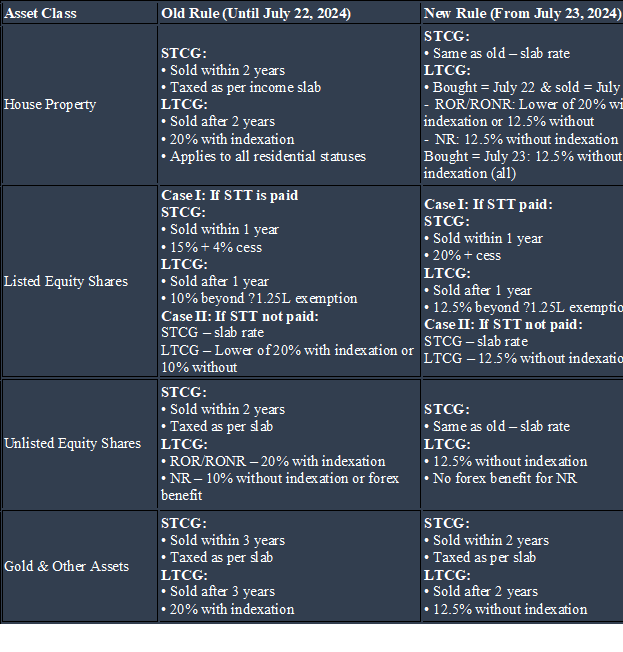
Here’s a breakdown of how capital gains are taxed for different asset classes, considering the pre- and post-July 23, 2024 scenarios:
- House Property
The taxation of house property capital gains depends on the date of acquisition and sale, as well as your residential status.
* Short-Term Capital Gains (STCG): If a house property is sold within 24 months of purchase, the gains are considered STCG and are taxed according to your applicable income tax slab rates, irrespective of your residential status (Resident Ordinary Resident – ROR, Resident Not Ordinary Resident – RONR, or Non-Resident Indian – NRI).
* Long-Term Capital Gains (LTCG):
* Property bought on or before July 22, 2024, and sold on or after July 23, 2024:
* ROR/RONR individuals have an option: pay 20% tax with indexation benefit or 12.5% tax without indexation. Taxpayers can choose the more beneficial option.
* NRIs will pay 12.5% tax without indexation.
* Property bought on or after July 23, 2024: LTCG will be taxed at a flat 12.5% without indexation for all taxpayers, regardless of residential status.
2. Listed Equity Shares
The tax treatment for listed equity shares depends on whether STT has been paid.
* STCG (Sold within 1 year):
* If STT is paid: Taxed at 20% plus cess (for transfers on or after July 23, 2024).
* If STT is not paid: Taxed at your income tax slab rates.
* LTCG (Sold after 1 year):
* If STT is paid: Taxed at 12.5% beyond the ₹1.25 lakh exemption limit (for transfers on or after July 23, 2024).
* If STT is not paid: Taxed at 12.5% without indexation.
3. Unlisted Equity Shares
* STCG: Taxed at your income tax slab rates.
* LTCG: Taxed at 12.5% without indexation. Note that NRIs do not receive forex benefits on unlisted equity.
4. Gold and Other Assets
* STCG (Sold within 2 years): Taxed at your income tax slab rates.
* LTCG (Sold after 2 years): Taxed at 12.5% without indexation under the new rules. Under old rules, a 3-year holding period for LTCG was applicable, taxed at 20% with indexation.
Filing Your Income Tax Return (ITR) for FY 2024-25 (AY 2025-26)
The Income Tax Department has enabled online utilities for filing ITR-2 and ITR-3 forms, which are relevant for individuals and Hindu Undivided Families (HUFs) with capital gains income.
* ITR-2: Used by individuals and HUFs who have income from capital gains but do not have earnings from business or profession.
* ITR-3: Applicable to taxpayers including stock traders, with provisions for reporting capital gains and other specified incomes.
Key Changes in Capital Gains Taxation:
- Flat LTCG Rate Introduced
– New Rate: Long-Term Capital Gains (LTCG) are now taxed at 12.5% across most asset classes.
– Old Rate: Previously, LTCG was taxed at 20% with indexation or 10% without indexation, depending on the asset.
– Impact: For assets acquired after July 23, 2024, indexation is not allowed, which may increase tax liability if inflation-adjusted cost was significantly higher.
1. STCG Rate Hiked for Listed Equities
– New Rate: Short-Term Capital Gains (STCG) on listed equities now taxed at 20% (up from 15%).
– Impact: Traders and short-term investors face higher tax liability.
2. LTCG Exemption Limit Raised
– New Limit: Exemption on LTCG from listed equity and equity mutual funds increased to ₹1.25 lakh (from ₹1 lakh).
– Impact: Slight relief for small investors.
3. Indexation Benefit Restricted
– Allowed Only If: Property was acquired before July 23, 2024.
– Impact: For newer acquisitions, no indexation, which may result in higher taxable gains.
4. Holding Period Simplified
– Listed Securities: LTCG if held >12 months.
– Other Assets: LTCG if held >24 months.
– Impact: Easier classification, but may affect timing strategies.
Conclusion:
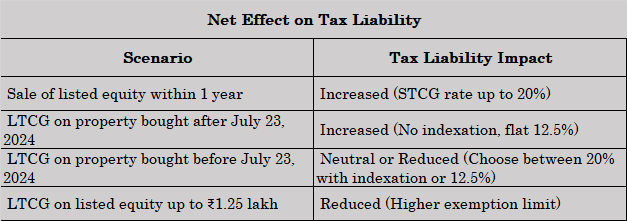
The capital gains tax amendments for Assessment Year 2025–26 have introduced a mix of increases and simplifications, depending on the asset type and transaction date. Here’s a breakdown of how they affect tax liability: