For Assessment Year (AY) 2026-27, tax audit reports under Section 44AB of the Income-tax Act, 1961 do not attract the newly proposed fixed late fees of ₹75,000, as that strict penalty regime applies only to subsequent tax years.
As the tax audit season peaks in September 2026, social media and professional forums have been buzzing with panic over a rumored ₹75,000 mandatory late fee for even a single day of delay in filing a tax audit report.
If you are a business owner, corporate manager, or taxpayer bracing for the upcoming deadlines, you can breathe a sigh of relief. That dramatic penalty structure does not apply to your current filings for Assessment Year 2026–27.
Let us break down what the rules actually say, why the confusion exists, and what regulations govern your audit report right now.
The Core Truth: AY 2026-27 Stays under the Income-tax Act, 1961
“Although the Income Tax Act, 2025 took effect from 1 April 2026, the income of FY 2025-26 (AY 2026-27) continues to be governed by the Income Tax Act, 1961. Tax audit for this year must still be filed using Forms 3CA / 3CB / 3CD — not the new Form 26.”
Because the financial year under review is FY 2025–26 (evaluated in AY 2026–27), the old legal framework stands firm. The rigid ₹75,000 or ₹1,50,000 fixed penalty slabs introduced for delayed audits are mapped exclusively to the new legislative framework starting from subsequent tax cycles.
What penalty applies instead for AY 2026-27?
While there is no sudden, fixed ₹75,000 late fee for a minor delay, a delayed tax audit report is still subject to the long-standing discretionary penalty rules under the old Act:
Governing Section: Section 271B of the Income-tax Act, 1961.
Penalty Amount: “0.5% of turnover / gross receipts, subject to a maximum of ₹1,50,000.”
The “Reasonable Cause” Shield: Unlike upcoming rigid fee structures where a one-day delay triggers a flat charge, Section 273B of the 1961 Act protects taxpayers who can prove a “reasonable cause for the failure” (such as sudden medical emergencies or natural disruptions).
Key dates for AY 2026-27 Audit & Returns
Do not mix up your submission milestones. Make sure these dates are marked on your calendar:
September 30, 2026: The due date to upload your Tax Audit Report (Forms 3CA/3CB and 3CD) on the e-filing portal.
October 31, 2026: The due date to file your actual Income Tax Return (ITR) for general tax audit cases.
November 30, 2026: The extended reporting/audit deadline for specified transfer pricing cases.
Summary checklist to stay stress-free
Don’t panic over rumors: Ignore viral forwards threatening an instant ₹75,000 penalty for a minor delay in your current AY 2026-27 audit report.
Coordinate early with your CA: Reconcile your GST, TDS, and ledger accounts well ahead of September 30, 2026, to prevent last-minute portal slowdowns.
Prepare for Future Shifts: Keep in mind that future assessment years will shift to the strict fixed-fee regime, making absolute punctuality the new normal.
In a significant legislative development, the Indian Parliament has passed the Micro, Small and Medium Enterprises Development (Amendment) Bill, 2026, marking one of the most important reforms to the MSME ecosystem since the enactment of the MSMED Act, 2006. The Bill was passed by the Rajya Sabha on 3 August 2026 and subsequently approved by the Lok Sabha on 7 August 2026.
The amendment seeks to modernize the legal framework governing MSMEs, improve ease of doing business, address the chronic issue of delayed payments, strengthen dispute resolution mechanisms, and promote digital governance. Given that MSMEs contribute significantly to employment, manufacturing, exports, and economic growth, the reform is expected to have far-reaching implications for India’s business landscape.
Why the amendment was needed
The MSMED Act was enacted in 2006, and over the past two decades India’s business environment has undergone substantial transformation due to technological advancements, digitization, evolving market dynamics, and growing integration with global supply chains. The government recognized the need to update the Act to reflect these changes and provide stronger institutional support to millions of enterprises across the country.
One of the most pressing challenges faced by MSMEs has been the issue of delayed payments from buyers, which often creates severe liquidity constraints. The new Bill addresses this challenge through stricter timelines, enhanced enforcement provisions, and modern dispute resolution mechanisms.
Key Features of the Amendment Bill
Revised MSME Classification Framework
The Bill empowers the Central Government to classify enterprises as MSMEs based on two criteria:
Investment in plant and machinery or equipment
Annual turnover
The thresholds will be notified by the government from time to time, providing flexibility to adapt to changing economic realities.
Permanent Digital Registration Platform
The amendment institutionalizes the Udyam Registration Portal as a free, digital, and voluntary registration platform for MSMEs. State governments may also establish linked digital platforms to facilitate registration and access to government benefits.
This move is expected to promote formalization and simplify compliance for businesses across the country.
Strengthening Delayed Payment Resolution
Perhaps the most impactful reform is the strengthening of mechanisms to address delayed payments.
The Bill introduces:
Online Dispute Resolution (ODR) systems.
Faster mediation and arbitration processes.
Stronger enforcement of awards and settlements.
These measures are intended to reduce litigation costs and improve access to justice for small businesses.
Mandatory Timelines for Dispute Resolution
The amendment provides specific timelines for dispute resolution:
Mediation must be completed within 90 days from the date of first appearance.
If mediation fails, the matter must be referred to arbitration within 30 days.
The arbitral award must be delivered within 90 days after completion of pleadings.
Such timelines can significantly reduce delays that have historically burdened MSMEs.
Enhanced Protection During Appeals
The Bill empowers courts to direct payment of at least 50% of the awarded amount to MSME suppliers when an application challenging the award remains pending for more than six months.
This provision is expected to improve liquidity and discourage frivolous delays by buyers.
Recovery of Awards as Arrears of Land Revenue
To ensure effective enforcement, mediated settlements and arbitral awards can be recovered as arrears of land revenue through the District Collector, Deputy Commissioner, or other notified authorities where the buyer’s assets are located.
This provision strengthens the ability of MSMEs to realize their dues.
Mandatory Use of TReDS by CPSEs
The Bill makes it mandatory for Central Public Sector Enterprises (CPSEs) to route settlement of MSME invoices through the Trade Receivables Discounting System (TReDS) platform. Governments may also extend similar requirements to other public sector entities.
This measure can improve cash flow and provide faster access to working capital for MSMEs.
Rationalization of Compliance Framework
The amendment also seeks to replace certain conviction-based penalties with graded civil penalties and administrative measures, thereby reducing regulatory burdens and promoting a more business-friendly environment.
Expected Impact on the MSME Sector
The amendment is expected to produce several positive outcomes:
Improved Cash Flow
Mandatory TReDS adoption and stronger payment enforcement can significantly reduce payment delays and improve working capital availability.
Faster Dispute Resolution
Defined mediation and arbitration timelines are likely to shorten dispute settlement cycles.
Greater Digital Adoption
The strengthened Udyam registration ecosystem and digital dispute resolution mechanisms support the government’s vision of digital governance.
Enhanced Investor Confidence
Clear legal protections and stronger enforcement mechanisms can encourage entrepreneurship and investment in the MSME sector.
Better Ease of Doing Business
Reduced compliance burdens and streamlined procedures can help MSMEs focus more on growth and innovation.
Challenges Ahead
While the amendments are promising, effective implementation will be critical. Success will depend on:
Adequate digital infrastructure.
Capacity building of Facilitation Councils.
Awareness among MSMEs about their rights and remedies.
Efficient coordination between central and state authorities.
Timely enforcement of dispute resolution timelines.
Without strong execution, the intended benefits may not fully materialize.
Conclusion
The Micro, Small and Medium Enterprises Development (Amendment) Bill, 2026 represents a landmark reform aimed at strengthening the backbone of India’s economy. By addressing delayed payments, promoting digital governance, streamlining dispute resolution, and enhancing liquidity for small businesses, the legislation seeks to create a more supportive and growth-oriented environment for MSMEs.
As India continues its journey toward becoming a global economic powerhouse, the successful implementation of these reforms could play a crucial role in unlocking the full potential of the MSME sector, fostering innovation, employment generation, and sustainable economic growth.
India has officially replaced the six-decade-old Income Tax Act, 1961 with the new Income Tax Act, 2025, effective from April 1, 2026. The reform focuses on simplification, clarity, and modernization rather than increasing tax burdens, marking a generational shift in India’s tax administration
The Income-tax Act, 2025 has been enacted to provide a streamlined, simplified, and modern tax code with reduced compliance burden, consolidated provisions, and clear definitions.
Background and Rationale
Old Act (1961): Over six decades, the Income Tax Act, 1961 became cluttered with thousands of amendments, judicial rulings, and circulars, making compliance complex and litigation-prone.
New Act (2025): Introduced to streamline tax law, reduce ambiguity, and align India’s tax framework with global best practices. It emphasizes clarity, simplicity, and taxpayer-friendliness.
Key Objectives
Simplification: Use of plain language and reorganized provisions.
Ease of Compliance: Standardized forms and processes.
Reduced Litigation: Clearer definitions and consolidated rules.
Modernization: Incorporates digital economy concepts like Virtual Digital Assets (VDAs) including cryptocurrencies.
Major Structural Changes
Feature
Old Act (1961)
New Act (2025)
Framework
Fragmented, amendment-heavy
Streamlined, consolidated
Terminology
“Assessment Year” & “Previous Year”
Unified “Tax Year”
Digital Assets
Ambiguous treatment
Defined category for VDAs
Forms
Complex, varied
Simplified & standardized
Key Tax Changes (Effective April 1, 2026)
Capital Gains: Revised rules for share buybacks and dividend taxation.
TCS (Tax Collected at Source): Streamlined provisions for better compliance.
Dividends & Buybacks: Clearer taxation framework to reduce disputes.
No Increase in Tax Burden: Rates remain unchanged; focus is on structure, not higher taxes.
Businesses: Improved ease of doing business due to reduced complexity.
Investors: Clearer rules on capital gains, dividends, and VDAs.
Tax Professionals: Less reliance on interpretative expertise; law is more self-explanatory.
Risks & Challenges
Transition Period: Taxpayers and professionals must adapt to new terminology and structures.
Interpretation Issues: While simplified, new provisions may still require judicial clarity in certain cases.
Digital Economy: Taxation of VDAs could pose compliance challenges for individuals unfamiliar with crypto assets.
Conclusion
The Income Tax Act, 2025 represents a landmark reform in India’s fiscal framework. By replacing the archaic 1961 Act, it aims to reduce complexity, modernize tax administration, and enhance transparency. For most taxpayers, the change is about simpler compliance rather than higher taxes, signalling India’s commitment to building a Viksit Bharat (Developed India) through efficient governance.
The Ministry of Corporate Affairs (MCA) has launched the MCA V3 portal, a significant upgrade over the earlier V2 system. This transition marks a new era in corporate compliance, offering improved efficiency, transparency, and user experience for companies, professionals, and regulators.
Here are the key highlights that you need to know about the newly launched V3 portal and how it impacts your business.
The V3 portal is designed to promote “Ease of Doing Business” through automation and real-time data integration.
Key Improvements Over MCA V2
Feature
MCA V2 Portal
MCA V3 Portal
Forms
Static PDF-based filings
Web-based forms with dynamic fields and real-time validations
Login
Password-based
Email + OTP login for enhanced security
Filing Process
Manual attachments, repetitive data entry
Pre-filled fields, linked filings, and conditional STP (Straight Through Processing)
Dashboard
Basic interface
“My Application” dashboard for tracking drafts, submissions, and status
Validation
Errors detected post-submission
Real-time validation before submission, reducing rejections
Utility Mode
Excel/PDF uploads
Web forms with integrated Excel utility
Transition Support
Limited guidance
Detailed FAQs and guides for professionals
Benefits for Stakeholders
Companies & Professionals: Reduced compliance burden through automation and pre-filled data.
Regulators: Improved accuracy and transparency with real-time validations.
Public Users: Enhanced accessibility and security with OTP-based login.
Improvements at a glance:
The MCA V3 portal is not just an upgrade—it is a transformation of India’s corporate compliance ecosystem. By introducing web-based forms, real-time validations, and a modern dashboard, MCA has significantly improved efficiency, accuracy, and transparency. For professionals and companies, mastering V3 is now essential to ensure smooth compliance in the digital era.
Conclusions
The digital transformation of company registration through MCA V3, combined with the surge in new company & LLP formation, marks one of the most important recent trends in India’s corporate regulatory space. It reflects both policy reform and entrepreneurial energy.
For anyone looking to start a business, this is a good time — the system is getting more entrepreneur-friendly, incorporating healthy corporate practices and more conducive for new ventures.
The MCA V3 portal is a ambitious step toward a paperless, transparent corporate environment. While the learning curve and initial glitches are challenging, the long-term benefits of real-time processing and integrated compliance would save businesses significant time.
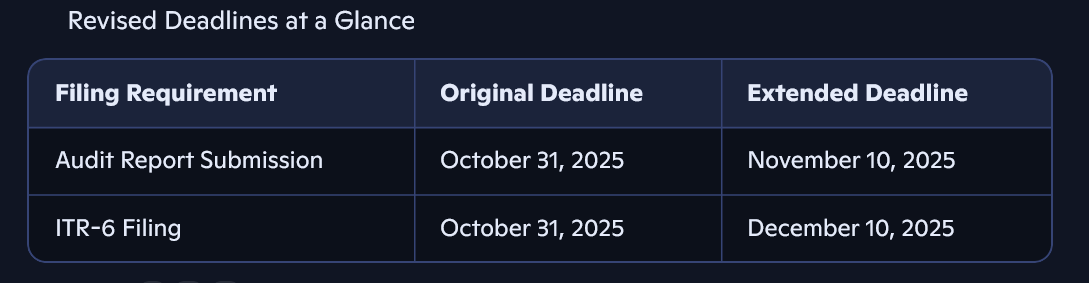
The Central Board of Direct Taxes (CBDT) has extended the due date for filing ITR-6 for AY 2025–26 by 10 days, moving the deadline from October 31 to December 10, 2025. This extension applies to companies and entities requiring audited financials.
In a welcome move for corporate taxpayers and professionals, the Central Board of Direct Taxes (CBDT) has announced a 10-day extension for filing Income Tax Return (ITR-6) for the Assessment Year (AY) 2025–26. The revised deadline is now December 10, 2025, replacing the earlier cutoff of October 31, 2025.
Who does this apply to?
This extension specifically benefits:
Companies and entities whose accounts are subject to audit under the Income-tax Act, 1961.
Assessees covered under clause (a) of Explanation 2 to sub-section (1) of Section 139, which includes firms and individuals with mandatory audit requirements.
Why the Extension?
The decision follows industry representations and logistical challenges faced by tax professionals in meeting the original deadlines. It also aligns with a recent Gujarat High Court directive that extended the audit report deadline to November 30, 2025.
Implications for Taxpayers
More time for compliance: Companies now have additional breathing room to finalize audited accounts and file returns accurately.
Avoid penalties: Timely filing by the new deadline helps avoid late fees and interest under Section 234F.
Better quality submissions: The extension allows for thorough review and error-free filings, especially for complex corporate structures.
What should you know?
Update your compliance calendar to reflect the new deadlines.
Coordinate with auditors to ensure timely submission of audit reports by November 10.
Prepare ITR-6 filings with all required disclosures, including tax audit details, transfer pricing reports (if applicable), and financial statements.
This extension is a strategic relief for stakeholders navigating the complexities of corporate taxation. As deadlines shift, staying proactive and organized remains key to smooth compliance. If you’re a tax professional or company executive, now’s the time to realign your filing strategy and ensure timely submission under the revised schedule.
In a significant move to ease compliance pressure, the Ministry of Corporate Affairs (MCA) has extended the deadline for companies to file their financial statements and annual returns for the financial year (FY) 2024–25 without additional fees until December 31, 2025, according to General Circular No. 06/2025 issued on October 17, 2025.
The extension was granted due to the deployment of revised e-forms on the MCA-21 Version 3 portal and requests from stakeholders.
The new deadline for filing financial statements and annual returns is December 31, 2025, with only normal fees applicable during this period.
This extension does not alter the statutory deadline for holding Annual General Meetings (AGMs). Companies should hold their AGM within the statutory deadline and file forms before December 31, 2025, to avoid extra fees. For more details, refer to the General Circular No. 06/2025.
The circular provides relaxation for the filing of following forms:
Form AOC-4 – Filing of financial statements
Form AOC-4 (CFS) – Consolidated financial statements
Form AOC-4 XBRL / Non-XBRL – For companies required to file in structured formats
Form MGT-7 / MGT-7A – Annual return for companies and small companies/OPCs respectively
Companies must take care that the ROC forms/returns are filed correctly and within the given date. Not adhering to the instructions can lead them to deal with various penalty charges and legal consequences.
Therefore, it is recommended that companies reach out to professionals to assist them in ensuring compliance with the filing needs.
The Ministry of Corporate Affairs has issued General Circular No. 06/2025 dated October 17, 2025, allowing companies to file their financial statements and annual returns for FY 2024–25 using the newly revised e-Forms (MGT-7, MGT-7A, AOC-4 series) on the MCA-21 Version 3 portal without additional fees until 31st December 2025.
This relaxation aims to help companies adapt to the new forms but does not extend statutory deadlines for holding AGMs under the Companies Act, 2013. Companies failing to meet statutory timelines remain liable for legal action, and filings made after this period will attract normal and additional fees as per applicable rules.
The Ministry has revised the e-Forms MGT-7, MGT-7A, AOC-4, AOC-4 CFS, AOC-4 NBFC (Ind AS), AOC-4 CFS NBFC (Ind AS), AOC-4 (XBRL) for annual filings, which were deployed on the MCA-21 Version 3 portal recently.
In view of the deployment of the new e-Forms, and considering that companies may require some time to get familiarized with the filing process, and keeping in view the requests received from various stakeholders, it has been decided that companies will be allowed to complete their annual filings pertaining to FY 2024-25 till 31st December, 2025 without payment of additional fees.
However, it is hereby clarified that this General Circular shall not be construed as conferring any extension of statutory time for holding of AGMs by the companies under the Companies Act, 2013 (the Act) and the companies which have not adhered to the relevant statutory timelines shall continue to be liable to legal action under the appropriate provisions of the Act.
Any filings made subsequent to the currency of this General Circular would attract payment of all fees, including additional fees, as provided in the Companies (Registration Offices and Fees) Rules, 2014, from the date when such filings were actually due under the Act.
This is issued with the approval of the Competent Authority.