10 points to focus when e-filing your income tax return
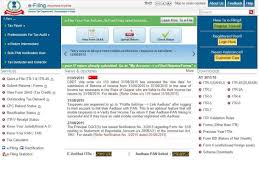
The income tax return (ITR) has to be filed by everyone whose income exceeds the basic exemption limit as allowed by the government regulations. However, the Indian government has made the ITR filing process quite easy and convenient by introducing on-line filing or e-filing. Unlike the traditional physical paper filing, e-filing saves time and enables users to calculate exemptions, claim refunds and avoid delays. Even then, many people make a few basic mistakes and consequently get IT notices for discrepancies, extra pay taxes and penalties.
Here are 10 aspects that you should keep in mind when e-filing your ITR, successfully.
– Selecting the right ITR form: The first step is to select the appropriate ITR form. As of now, there are seven ITR forms depending on what kind of income you have. For instance, ITR1 is applicable to any individual with only salary income. On the other hand, if one has capital gain along with salary, he/she should opt for ITR2. It is mandatory to select the correct ITR form so that your income tax return filing does not get rejected by the Income Tax Department.
– Furnishing correct personal details: You are required to furnish all your personal details such as PAN , e-mail ID, contact number, bank account number and IFSC accurately to avoid rejection of your ITR filing. In case you provide a wrong PAN, the IT department will reject your e-filing as there will be a data mismatch (your details and the details generated by the wrong PAN will differ). Moreover, if you do not provide the correct mobile number and e-mail address, it will lead to incomplete e-filing as the one-time password (OTP) and any other communication will be done through your registered contact details only.
– Mentioning all sources of income: People often forget or do not bother to mention the tax-exempted amount. It is, however, advisable to mention both taxable as well as non-taxable income. Exempted income may include interest earned on savings accounts and/or fixed deposits or earning through selling shares or mutual fund units. You should mention all the sources of income in the form as not mentioning the same would be considered as ‘concealment of income’. This may lead to IT notices, as concealment of income is against the law.
– Claiming deduction under appropriate section: Claim your deductions under the appropriate section of the Income Tax Act or it may lead to more tax liabilities. For example, it is incorrect to claim employer’s contribution to the EPF under section 80C while the principal repaid for housing loan falls under section 80C. Again, if you have made some investments that are exempted under Chapter VIA, but forget to mention it while e-filing the ITR, you may lose the money by paying taxes or may lose the opportunity for tax refund. Therefore, it is essential to mention all your deductions under appropriate sections.
– Verifying tax credits: Check your Form 26AS before e-filing ITR. Form 26AS includes all your income details, taxes deducted at source (TDS), advance tax paid by you, self-assessment tax and so on. If you are a salaried person with Form 16, cross-check your income and tax details with Form 26AS to avoid any discrepancy, which may lead to less refund or more payable taxes.
– Mentioning multiple properties: If you have more than one property, whether occupied by you or not, you can claim a refund on only one property under the Income Tax Act, 1961 . Other properties will be deemed as let out and will be taxed at applicable municipal rates. It is advisable to furnish the details of all your properties or you may be accused of violation of Income Tax Act for concealment of income.
– Getting TDS deducted more than once: Such mistakes generally happen when individuals switch jobs in a single financial year. It is obvious that your first employer had sent the TDS to the government depending on the income you had earned there. However, your second employer may deduct your TDS again for the same financial year assuming you did not pay it earlier. To avoid such double deductions, it is advisable to share all your TDS details with your new employer. In the ITR form, you should disclose your income and tax details related to both organisations (or more, in case that is applicable). This will not only help you avoid double taxation, but may also provide you with more refundable amount.
– Discrepancies in TDS details: It is always advisable to check your TDS deductions and deposits made by your employer/deductor to avoid any misfiling of your ITR or losing any refund. It is possible that the deductor has failed to deposit your deducted TDS to the government. Undoubtedly, the deductor will face consequences for not depositing the same. However, it is better to avoid any delay in your refund process or pay much more in taxes due to someone else’s mistake. To avoid such consequences, cross-check your TDS deducted with Form 26AS. If your TDS is deducted and deposited to the government quoting your PAN correctly, it will reflect on your Form 26AS. If you find any discrepancy, act immediately and avoid any delay.
– Paying advance tax/self-assessment tax: It is advisable to pay the liable advance tax or self-assessment tax before March 31 of the financial year. It is normal to have income where TDS is not applicable. In such cases, you need to calculate your liable tax and pay it to the government. If you fail to do it, you will be penalized at the rate of 1 per cent per month starting from April 1 of the next financial year.
– Verifying ITR-V: The process of e-filing does not end with submitting your ITR form. You should send the acknowledgement (ITR-V) – the IT Department will share it on your registered email ID – to CPC, Bangalore. This step is not required if you have e-filed your ITR with digitized signature / e-verified. The ITR-V should be sent via speed post within 120 days after filing your ITR. Further, keep a track of the ITR-V to ensure that it reaches the CPC timely. If the CPC does not receive your ITR-V within 7-10 days of posting, contact them on their toll-free number 1800-425-2229 and resend the copy.
If you keep in mind the above-mentioned points while e-filing your ITR, you will not face any delay or cancellation of return, and may get refund swiftly.
For any assistance in e-filing the Income Tax Returns, you can contact our team of charted accountants, who can help to file a proper response and for filing of Returns, or any tax related queries so that compliance can be made duly.