ITR filing is mandatory for individuals who have an annual income exceeding the basic exemption limit.
There are various types of Income Tax return forms that taxpayers have to fill to complete filing Income Tax Return process.
These ITR forms are classified on the basis of the nature of income.
The Central Board of Direct Taxes (CBDT) releases a set of ITR forms tailored for different categories of taxpayers.
Choosing the right form is crucial for filing and for processing without any delays.
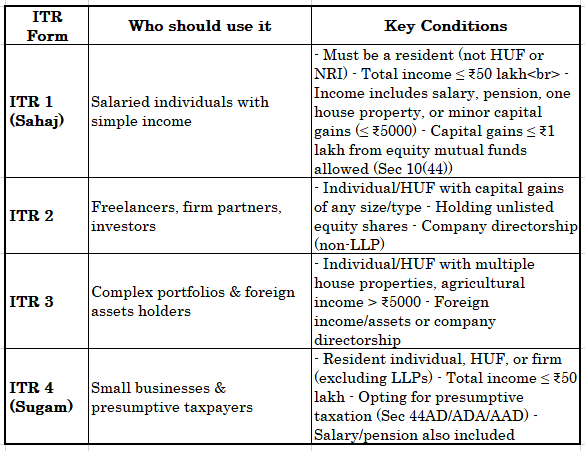
Here is a simplified guidance of the main ITR forms applicable for Assessment Year 2025–26:
ITR-1 Form: This form is for a resident individual whose total income includes-
- Income earned from salary or Pension.
- Income from other sources, excluding income from winning a lottery or income from owning and maintaining race horses, is taxable under section 115BBDA or section 115E.
- Income from One House Property; however, in this form, the loss brought forward from previous years are not eligible.
- Income from agriculture activities up to Rs 5000.
- The total income of the individual should not exceed 50 Lakhs.
ITR-2 Form: This form is for individuals or a HUF (Hindu Undivided Family) whose income includes:
- Income from salary or Pension
- Income from House Property(one or more)
- Income from other sources, including income from winning a lottery, income from owning and maintaining horse races, or income taxable at special rates.
- Persons who had investments in unlisted equity shares at any time during the entire financial year.
- An individual who is a director in a company.
- An individual who is a Resident (ROR/RNOR)or non-resident.
- Income earned from capital gains
- Income from foreign assets/ other foreign income.
- Agricultural income of more than Rs 5,000/-
- Incomes where clubbing provisions are applicable
- Individuals having a financial interest in assets located outside India, which includes any signing authority for accounts held outside India.
- One who desires to carry forward or bring forward loss under income from house property.
- Any tax has been deducted under Section 194N
- In cases where payment or deduction of tax has been deferred on ESOP (Total income can exceed 50 lakhs in this ITR Form)
ITR-3 Form: This form is to be used by either an individual or a Hindu Undivided Family who are carrying on a profession or a business. The following persons are eligible to fill this form:
- The residential status can be either Non-resident or Resident (ROR/RNOR)
- If a person is the director of the company.
- Persons who had investments in unlisted equity shares at any time during the entire financial year.
- Income from other sources
- Income of a person who is a partner in a firm.
- Income from salary or Pension
- Income from House Property(one or more)
- Total income can exceed 50 lakhs in this case.
- Income earned from capital gains or foreign assets/foreign income.
- Who has income under the head profits or gains of business or profession and who is not eligible to file Form ITR-1 (Sahaj), ITR-2, or ITR-4 (Sugam).
- In short, individuals or HUFs who are not eligible to file ITR-1, ITR-2, and ITR-4 should file ITR-3
ITR-4 Form: This form is applicable to both the resident individuals and HUFs.
- Other than LLPs, all partnership firms which are residents and have an income that is either professional or from the business.
- Those persons who have opted for a presumptive income scheme according to Section 44AD, Section 44AE, and Section 44ADA of the Income Tax Act.
- If the person’s business turnover exceeds Rs. 2 crores, then he is required to file ITR-3 with the Audit report and not ITR 4.
- The total income for ITR 4 should not exceed Rs. 50 lakhs.
- Income from One House Property(loss brought forward from previous years or carry forward of losses are not eligible in this ITR Form ).
- Income from Salary or Pension.
- Income from other sources. (excluding income from winning a lottery or income from owning and maintaining race horses, income taxable under section 115BBDA or 115BE).
Why it matters
Filing the right form is important, for processing of the ITR and to get refund, if applicable. If right form is not filed, it can lead to:
- Return being marked as defective
- Loss of deductions and refunds
- Extra scrutiny from tax authorities
Each form aligns with specific income types and taxpayer profiles. A salaried individual with no investments doesn’t need the complexity of ITR 3. Similarly, a small business owner can save time with ITR 4 using the presumptive taxation scheme.
Tips for filing
- Use the latest instructions issued by the Income Tax Department.
- Double-check PAN and bank details. It speeds up refund processing.
- Declare all sources of income, even those exempted, like interest from PPF.
- Use Form 26AS and AIS to cross-check what the department already knows about your earnings.