ECB boost for India, world markets

http://bsmedia.business-standard.com/_media/bs/img/article/2015-08/20/full/1440058499-7556.jpgThe Indian markets on Friday climbed to a two-month high after a rally in global equity markets in the wake of the European Central Bank (ECB) hinting at fresh stimulus measures. Most Asian markets ended up a little over one per cent, while Europe gained around two per cent.

The BSE exchange’s benchmark Sensex rose 183 points or 0.7 per cent to 27,470.8, the highest since August 20. This was its fourth straight weekly advance. The National Stock Exchange’s Nifty rose 0.5 per cent or 43.75 points to 8,295.45.

Experts said the markets could continue the upward trajectory as the Chinese central bank cut interest rates and the reserve ratio to give a boost to its economy. The announcement by People’s Bank of China, after the close of Indian markets, further buoyed the European and US futures markets.

“Both the ECB and China stimulus announcements are positive for the market, at least in the short term,” said U R Bhat, managing director, Dalton Capital Advisors. “However, these are artificial doses and when the central banks withdraw the stimulus there could be a lot of pain.”

The latest round of monetary easing, the sixth since November last year, comes as China’s growth rate for the September quarter dipped below seven per cent for the first time since the 2008 global financial crisis.

“The move by China might have a positive impact on the market in the near term. But, it indicates the extent of problem in the Chinese economy. On the margin, it is negative. One cannot rule out an increase in volatility, going ahead,” said Tirthankar Patnaik, India strategist, Mizuho Bank.

The stimulus packages by central banks in China and Europe might support stocks in the immediate term but the market remains vulnerable to correction, following the sharp gains made over recent weeks, say experts.

So far in October, the Sensex has gained five per cent, on the back of foreign flows of nearly $900 million. The index had declined nearly six per cent and one per cent in August and September, respectively.

“The next sets of (companies’) results are expected to be weak. The market could react negatively if there is earnings disappointment,” said Bhat.

ITC, which gained 2.8 per cent, was the best performing Sensex stock on Friday. Other major gainers were Axis Bank and GAIL. Bharti Airtel fell 3.4 per cent, the most among Sensex companies. Vedanta, Larsen & Toubro and Maruti Suzuki fell a little over two per cent each.

Foreign investors net-bought shares worth Rs 230 crore, while domestic institutions were net sellers by Rs 156 crore on Friday, provisional data showed.
The Indian markets on Friday climbed to a two-month high after a rally in global equity markets in the wake of the European Central Bank (ECB) hinting at fresh stimulus measures. Most Asian markets ended up a little over one per cent, while Europe gained around two per cent.

The BSE exchange’s benchmark Sensex rose 183 points or 0.7 per cent to 27,470.8, the highest since August 20. This was its fourth straight weekly advance. The National Stock Exchange’s Nifty rose 0.5 per cent or 43.75 points to 8,295.45.

Experts said the markets could continue the upward trajectory as the Chinese central bank cut interest rates and the reserve ratio to give a boost to its economy. The announcement by People’s Bank of China, after the close of Indian markets, further buoyed the European and US futures markets.

“Both the ECB and China stimulus announcements are positive for the market, at least in the short term,” said U R Bhat, managing director, Dalton Capital Advisors. “However, these are artificial doses and when the central banks withdraw the stimulus there could be a lot of pain.”

The latest round of monetary easing, the sixth since November last year, comes as China’s growth rate for the September quarter dipped below seven per cent for the first time since the 2008 global financial crisis.

“The move by China might have a positive impact on the market in the near term. But, it indicates the extent of problem in the Chinese economy. On the margin, it is negative. One cannot rule out an increase in volatility, going ahead,” said Tirthankar Patnaik, India strategist, Mizuho Bank.

The stimulus packages by central banks in China and Europe might support stocks in the immediate term but the market remains vulnerable to correction, following the sharp gains made over recent weeks, say experts.

So far in October, the Sensex has gained five per cent, on the back of foreign flows of nearly $900 million. The index had declined nearly six per cent and one per cent in August and September, respectively.

“The next sets of (companies’) results are expected to be weak. The market could react negatively if there is earnings disappointment,” said Bhat.

ITC, which gained 2.8 per cent, was the best performing Sensex stock on Friday. Other major gainers were Axis Bank and GAIL. Bharti Airtel fell 3.4 per cent, the most among Sensex companies. Vedanta, Larsen & Toubro and Maruti Suzuki fell a little over two per cent each.

Foreign investors net-bought shares worth Rs 230 crore, while domestic institutions were net sellers by Rs 156 crore on Friday, provisional data showed.

India, Singapore to sign strategic partnership pact during PM’s visit

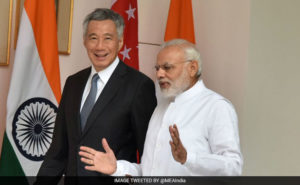
Taking their bilateral ties to the next level, India and Singapore are expected to sign a strategic partnership pact during prime minister Narendra Modi’s visit to that country from November 23 to 25.

The broad contours of the agreement were also discussed during the fourth India-Singapore joint ministerial committee meeting held here on Tuesday. It was co-chaired by external affairs minister Sushma Swaraj and her Singaporean counterpart Vivian Balakrishnan.

The strategic partnership agreement would comprise expansion of cooperation in five main areas: Scaling up investment and trade; speeding up air and maritime connectivity; smart city development and urban rejuvenation; skills development and capacity building, and state focus on strengthening business and cultural links, according to a press release issued by the Singapore High Commission.

“The strategic partnership will come with deliverables and concrete outcomes, with focus on urban solutions, smart cities and knowledge and skill transfer,” Balakrishnan told reporters after the meeting.

Balakrishnan also highlighted the need to enhance connectivity between India and Singapore, particularly in the aviation sector.

He also highlighted Singapore’s contributions to India in the areas of smart cities and skills development.

“Both ministers agreed on the need to enhance economic cooperation, including expanding trade and investment between both countries,” the release stated.

This will be Modi’s second visit to Singapore as India’s prime minister. He last went there in September to attend the funeral of Singapore’s founding father Lee Kuan Yew.

Singapore is planning for a similar reception Modi had received in San Jose in US last month. He has also been chosen to deliver the prestigious “Singapore Lecture” during the visit.

Source: http://www.business-standard.com/article/economy-policy/india-singapore-to-sign-strategic-partnership-pact-during-pms-visit-115101300787_1.html

Start-up investments in India to see three-fold rise to $6.5 bn in 2015: Nasscom

NASSCOM President R Chandrashekar (C), Chairman NASSCOM Product Council Ravi Gururaj (R) and Vice President NASSCOM 10K Strart-up Rajat Tandon releasing the second edition of the start-up report

India will witness about $6.5-billion (Rs 42,300 crore) funding in start-ups this year, as global investors look at investing in firms that build products and solutions for the local market, while using them for emerging markets in Asia, Africa and Latin America. India is the world’s third largest start-up hub.

Global private equity (PE) and venture capital (VC) firms spent $2.2 billion (Rs 14,300 crore) in 179 Indian start-ups in 2014. Till October, these firms doubled their investments to $4.9 billion (Rs 31,900 crore) and expect to increase them to $6.5 billion by the end of the year, according to industry body National Association of Software and Services Companies (Nasscom). Indian start-ups that received funding doubled to 400 in 2015, said a Nasscom report, released during the product conclave that began Tuesday. The report added investors had reaped returns in 2015, with exits touching $700 million.

India sees four start-ups emerge every day. Those who get funded get an average valuation of $2.7 million and nearly two thirds of them are concentrated in Bengaluru, Mumbai and the National Capital Region.

The number of start-ups in India is set to cross 4,200 by the end of 2015. About 1,200 technology start-ups were incepted in India this year, of which more than 50 per cent were in the e-commerce, consumer service and aggregator space. Unlike in the West, a majority of the Indian start-ups were focused on solving community problems using technology solutions in health care, education, social platforms, hyper local services and analytics. “Apart from positively impacting the lifestyles of citizens involved, start-ups are creating innovative technology solutions that are addressing the key social problems that India is facing and creating significant growth opportunities for stakeholders,” said R Chandrashekhar, president of Nasscom.  There are about 292 active angels and 156 active VC and PE players in the country.

The number of active investors has more than doubled from 220 in 2014 to 490 this year. Eight of the top-10 investing PE, VCs in India is foreign.

The number of accelerators and incubators has grown by 40 per cent over 2014 to touch 110. India has also emerged as the youngest start-up country with the average age of start-up founders at 28 years.

The second edition of 10,000 Start-ups Report has also accommodated a 10-point agenda for the government to cultivate the start-up culture of India,including definition of start-ups, taxing rules, regulations in terms of funding, online payments and branding.

Source: http://www.business-standard.com/article/companies/start-up-investments-in-india-to-see-three-fold-rise-to-6-5-bn-in-2015-nasscom-115101300983_1.html