Dr (Mrs) Ameenah Gurib-Fakim, the President of the Republic of Mauritius called on President Pranab Mukherjee at Rashtrapati Bhavan today.
Welcoming Dr. Ameenah Gurib-Fakim on her first visit to India, President Mukherjee congratulated her on being the first woman President of Mauritius.
President Mukherjee said people of India are delighted that Dr. Ameenah Gurib-Fakim has personal, professional and academic linkages with India.
India attaches high importance to its relations with Mauritius which has a very special place in the hearts and minds of the Indian people.
The President expressed confidence that with the achievements of the President of Mauritius in the fields of science and technology, education and innovation, Mauritius will become stronger and a new dynamism will be added to India-Mauritius bilateral relations.
The President of Mauritius conveyed her condolences to people of Chennai who are suffering on account of floods. She described Indians as brothers and sisters and not just friends.
She conveyed gratitude for India’s assistance in the development of Mauritius ever since its independence and called for a continuation of the close ties in the coming days based on institution and capacity building.
The smart cities planned by the government will use nearly 1.6 billion of connected things or Internet of Things (IoT) by 2016, an increase of 39% from 2015, Gartner said in a report.
IoT is the network of physical objects or “things” embedded with electronics, software, sensors, and network connectivity, which enables these objects to collect and exchange data.
“Smart commercial buildings will be the highest user of IoT until 2017, after which smart homes will take the lead with just over 1 billion connected things in 2018,” said Gartner’s Research vice president Bettina Tratz-Ryan.
Commercial real estate benefits greatly from IoT implementation as it creates a unified view of facilities management as well as advanced service operations through the collection of data and insights from a multitude of sensors.
“Especially in large sites, such as industrial zones, office parks, shopping malls, airports or seaports, IoT can help reduce the cost of energy, spatial management and building maintenance by up to 30%,” Tratz-Ryan said.
The business applications that are fuelling the growth of IoT in commercial buildings are handled through building information management systems that drive operations management, especially around energy efficiency and user-centric service environments, Gartner said.
“In 2016, commercial security cameras and webcams as well as indoor LEDs will drive total growth, representing 24% of the IoT market for smart cities,” she said.
Tratz-Ryan further said IoT deployment in commercial buildings will continue to grow at a rapid pace over the next few years, and is on pace to reach just over 1 billion in 2018.
“Incentives into the deployment of IoT in commercial real estate will fuel its development,” she added.
Uber’s fund-raising efforts are showing no signs of slowing down. The company, based in San Francisco, is close to completing the raising of a $2.1-billion round of venture capital, according to people briefed on the company’s plans, the company’s single-largest round to date.
Once completed, the investment will value the company at $62.5 billion, according to three people briefed on the plans, securing Uber’s place as the world’s most valuable private start-up.
Tiger Global Management participated in the newest round, led by its partner Lee Fixel, as did T Rowe Price, said the people, who spoke on the condition of anonymity because the terms are still private.
Talks of the funding plans were previously reported by The New York Times in October. On Thursday, Bloomberg News reported the $62.5-billion valuation.
Uber declined to comment on any fund-raising talks, as did T Rowe Price. A Tiger Global spokeswoman declined to comment.
Competition is intensifying in the global ride-hailing market, as rivals like Lyft, Didi Kuaidi and other companies raise billions of dollars in to expand as quickly as possible. Lyft, another ride-hailing start-up, is in talks to raise a further $500 million in funding, according to four people briefed on the round, which could value the company at roughly $4 billion. Didi Kuaidi, to date, has raised more than $4 billion in private investment.
The participation of Tiger Global, however, is particularly interesting. Tiger Global is an investor in Ola and GrabTaxi, two of Uber’s largest competitors in India and Southeast Asia.
It is perhaps the first time a major institutional investor participated in the rounds of both Uber and its major competitors. And on Thursday, Ola and GrabTaxi announced a strategic partnership with Lyft, which is also based in San Francisco and is Uber’s major competitor in the United States.
Banks are taking over companies under the strategic debt restructuring (SDR) scheme and forcing defaulters to sell assets.
On November 30, banks announced the conversion of Rs 15,000 crore of Gammon India’s loans into equity. On the same day, they informed Hyderabad-based road developer IVRCL that they were converting Rs 7,500 crore of loans into equity.
On Thursday, Electrosteel Steels said its board of directors would meet on December 8 to take on record an SDR package. The Kolkata-based Electrosteel Steels owes banks Rs 9,500 crore.
Banks have also invoked SDR against Lanco Teesta Hydro Power, VISA Steel, Jyoti Structures, Monnet Ispat and Energy.
The SDR scheme was cleared by the Reserve Bank of India in June. The scheme was introduced because banks felt the corporate debt restructuring (CDR) scheme failed to help them recover their money. The CDR cell had approved restructuring loans worth Rs 4 lakh crore till March this year. Under the SDR scheme, banks convert loans into equity and can change the management of the company.
“Banks are not in a mood to listen to borrowers. That is why we are selling our assets in India and abroad to avoid the SDR scheme,” said the promoter of a large corporate group who did not wish to be named. With SDR as a stick, banks have also put defaulters on notice that if they are unable repay loans by selling assets then they will do it for them. This has expedited the sale of assets by many debt-laden groups.
Essar Steel announced on November 8 it had appointed SBI Caps and ICICI Securities to sell stakes in the company. This was apart from its own plans to sell assets worth Rs 11,200 crore by March 2016. “The promoters will infuse another Rs 1,500 crore into the company in 2015-16,” Firdose Vandrevala, executive vice-chairman, Essar Steel, had said in a recent interview.
Soon after selling its two telecom circles to Idea Cellular, Videocon Industries said it would sell telecom assets, including spectrum, worth Rs 14,000 crore to bring down its Rs 39,000 crore net debt.
The Anil Ambani-owned Reliance Infrastructure said it would sell its cement assets and 11 road projects to cut its Rs 25,000 crore debt. On Friday, another Ambani company Reliance Communications announced its plans to sell its telecom tower company to private equity firms, Tillman Global and TPG to reduce its debt. Hyderabad based GMR and GVK are also taking steps to raise funds. On Friday, GMR announced that it is raising $300 million by way of a foreign currency convertible bond. Similarly, GVK is planning to get an investor for its airport arm. Most debt-heavy companies have been battered on the stock exchanges as investors fear asset sales will pull down future sales and profits.
Banks have also been aggressive with Vijay Mallya, chairman of the UB Group who defaulted on Rs 7,000 crore of loans taken by Kingfisher Airlines and have declared him as a defaulter.
* Dollar at highest since March vs currency basket, euro down
* China’s yuan strengthened after IMF decision
* U.S. stocks down ahead of data; Asia dips, Europe up
* ECB stimulus expectations lift European stocks
* Oil rises ahead of ECB meeting, OPEC on Friday (Updates to afternoon, adds commentary)
* * * * * * * * * *
The dollar hit an eight-and-a-half-month high against major currencies Monday as the prospect of further European Central Bank stimulus dragged the euro down to its weakest since mid-April, while oil prices retreated.
Global stock markets were mixed, with Wall Street falling ahead of a crucial payroll report Friday, while European shares rose. Still, the three major U.S. indexes were set to end the month higher for a second straight month.
The jobs report is arguably the most important U.S. economic indicator due out before the Federal Reserve decides on Dec. 16 whether or not to raise interest rates for the first time in nearly a decade.
“The market has largely priced in a December hike and it would have to take a pretty significant miss with the jobs report to give the Fed some pause before its next meeting,” said Randy Frederick, managing director of trading and derivatives for Charles Schwab in Austin.
The Dow Jones industrial average fell 49.9 points, or 0.28 percent, to 17,748.59, the S&P 500 lost 6.37 points, or 0.3 percent, to 2,083.74 and the Nasdaq Composite dropped 16.24 points, or 0.32 percent, to 5,111.28.
The week is expected to highlight the divergent economic policies in the United States and the euro zone, which may set the tone for markets early next year.
European shares were lifted by the prospect of the ECB unveiling an extension of its bond-buying program at a Thursday meeting. The pan-European FTSEurofirst 300 index rose 0.4 percent for a 2.3-percent monthly gain.
The dollar index, which measures the greenback against a basket of major currencies, was up 0.16 percent despite disappointing data on U.S. business sentiment and pending home sales. It hit its highest point since mid-March and was set for its biggest monthly rise since January.
“The market’s really kind of looking through the numbers that are coming out right now and more looking towards the end of the week and central bank discussions,” said Douglas Borthwick, managing director at Chapdelaine Foreign Exchange in New York.
The euro fell 0.2 percent against the dollar to its lowest point since April.
The MSCI index of world stocks was off 0.4 percent and on track for a 0.9 percent decline for November.
Brent futures were lower and U.S. crude gave back earlier gains on Monday as a pre-OPEC-meeting rally and run-up in U.S. refined oil products faltered.
U.S. crude futures settled down 6 cents, at $41.65. Brent crude, the global benchmark ended down 25 cents, at $44.61 per barrel.
Gold, on track for its worst month since June 2013, traded up 0.7 percent at $1,065.86 an ounce.
U.S. Treasuries prices rose modestly Monday on hesitation ahead of speeches from top Federal Reserve speakers throughout the week. Benchmark 10-year Treasuries rose 2/32 in price to yield 2.221 percent, down from 2.222 on late Friday. The 30-year bond was up 6/32 in price to yield 2.99 percent.
Aside from these legacy issues, the underlying asset trend for Indian banks will be stable because of a generally supportive operating environment, said Moody’s Vice President.
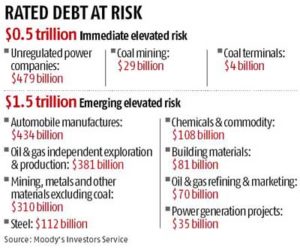
Many sectors, other than power and coal, face environmental risks that could translate into credit risk, according to Moody’s Investor Service. These include automobiles, oil & gas, mining, steel, and commodity chemicals. Moody’s has identified 11 sectors with around $2 trillion in rated debt as having credit exposure to environmental risks in the next five years.
At the same time, 57 sectors, representing $59 trillion of rated debt, are considered low risk, with environmental risks unlikely to materially impact credit quality. While some like telecommunication operate with fundamentally low exposure to environmental risks, others such as banks and insurance companies, have business diversity to mitigate their current exposures.
Unregulated power generators, which do not receive the benefits of cost recovery from their customers, coal mining and coal terminals, are the most exposed. Moody’s has developed a heat map that qualitatively scores the relative exposure of 86 sectors globally to environmental risks, in terms of both the materiality and timing of any likely credit effects. The amount of rated debt covered by this sector review is $67.9 trillion.
Environmental risks have been classified into two broad categories — the effects of environmental hazards, and the consequences of regulation designed to prevent or reduce those hazards.
Another set of 18 sectors, accounting for $7 trillion in rated debt, face environmental risks that could be material, but over five or more years. In this “emerging, moderate risk” category are developing economy sovereign and regional governments, integrated oil & gas companies and regulated power generation utilities. These have a clear exposure to environmental risks that could affect their credit quality. However, it is less certain that the identified risks will develop in a way to impact credit ratings for most issuers in these sectors.
“The longer runway to respond to risks could provide time to implement policy changes, adjust business models or financial profiles, or develop technological or lower-cost solutions, mitigating the impact of such risks,” said the report.
Sovereigns with developing economy as well as regional and local governments face increasing infrastructure challenges to manage environmental risks from water shortages, pollution or natural disasters. Unlike the overall scores, the sub-category scores were assessed based on the sector’s general level of exposure to that particular environmental risk, rather than any potential to affect ratings.
European Central Bank (ECB) President Mario Draghi adddresses the European Banking Congress at the Old Opera house in Frankfurt, Germany November 20, 2015.
The world’s two biggest central banks will move decisively in opposing directions next week, with the European Central Bank (ECB) almost certain to ease policy on Thursday and a US jobs report likely to seal the case for a Fed rate hike in December.
Building a solid case for more easing on fears of anemic inflation, the ECB has all but committed itself to action, with the markets now guessing only about what exact steps it will take to kick-start price growth.
Still, there is plenty of room for surprises. The ECB will contemplate a wide range of measures, from a fairly uncontroversial deposit rate cut to more extreme – but highly unlikely – moves such as buying rebundled non-performing loans to resurrect bank lending.
“With expectations high, the risk of disappointment is also high but as concerns are correctly focused on the structural headwinds to the inflation outlook, there is really no point in holding back or saving ammunition at this stage,” Societe Generale said in a note to clients.
ECB President Mario Draghi has done his share to raise expectations. He has warned about increased risks to growth and inflation, and said “we will do what we must” to raise inflation as quickly as possible.
A Reuters poll of more than 50 economists predicted that the ECB would opt for a deposit rate cut to -0.3 per cent from -0.2 per cent, an expansion of its asset buying program to euro 75 billion per month from euro 60 billion, and an extension of that buying beyond September 2016.
There are a range of variations on this pattern, though. The ECB could opt for a deeper deposit rate cut, or it could add assets like corporate or municipal debt to those that it buys. It could even set a staggered deposit rate, punishing those who park large amounts of cash in its vaults.
The biggest complication to all this is the small but significant group of opponents to such action, led by Bundesbank chief Jens Weidmann and board member Sabine Lautenschlaeger, who broke ranks with their Governing Board peers recently to openly oppose further easing.
Overwhelm
Arguing that loose monetary policy poses risks and merely buys time to fix structural problems, Lautenschlaeger has taken a stance against any more steps, especially an expansion of the asset-buying program.
Draghi may have his work cut out bridging the gap between their views, as the ECB rarely votes at meetings and instead decides on policy with the broadest possible consensus.
His opponents could also make it tough for Draghi to continue his practice of promising big things, then exceeding the already heightened expectations.
“Expectations have increased further ahead of next week’s ECB meeting and ECB speakers have not done much to rein in expectations.
Draghi has overdelivered in the recent past but it could be harder this time given how much has been promised,” Deutsche Bank analysts wrote in a note to investors.
Citigroup said that to surprise the markets, the ECB would need to cut the deposit rate, increase its monthly bond-buying and adjust its forward guidance by extending the program or removing its reference to ending it next September.
While the euro area struggles with weak growth and high unemployment, the US is continuing to create jobs quickly. Data on Friday is expected to show that US non-farm payrolls increased by 200,000 in November, keeping the jobless rate at a 7-1/2 year low of 5.0 per cent.
But even if the figures disappointed somewhat, the Fed is still expected to hike at its meeting on December 15-16 given near full employment, with the debate likely shifting to future rate hikes rather than near term moves.
The biggest headwind for the Fed could be the dollar’s rapid firming against major currencies in recent months, which has already effectively tightened monetary conditions. But U.S. trade is less exposed to currency moves than elsewhere, such as in Europe, so the impact on policy is smaller.
Fed Chair Janet Yellen’s testimony to the Joint Economic Committee of the Senate on the economic outlook, due at the same time as Draghi’s press conference, will likely give more clues about the Fed’s next moves.
Among other top central banks, the Reserve Bank of Australia and the Bank of Canada are both expected to keep rates on hold with their respective economic outlooks in line or slightly better than their previous forecasts.

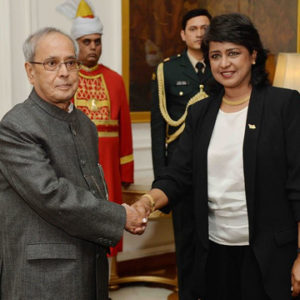 Dr (Mrs) Ameenah Gurib-Fakim, the President of the Republic of Mauritius called on President Pranab Mukherjee at Rashtrapati Bhavan today.