Skip to Main Content
SunKrish Global Consulting & Corporate Services
  • About Us
  • Services
  • Our Team
  • Resources
  • Posts
    • Company Incorporations, MCA Returns
    • Accounting, Compliance, Auditing
    • ITRs – Individuals, Firms, Companies
    • Goods & Services Tax (GST)
    • Corporate & Business Advisory
  • Contact Us
  • About Us
  • Services
  • Our Team
  • Resources
  • Posts
    • Company Incorporations, MCA Returns
    • Accounting, Compliance, Auditing
    • ITRs – Individuals, Firms, Companies
    • Goods & Services Tax (GST)
    • Corporate & Business Advisory
  • Contact Us

Permanent Account Number (PAN)

9 Sep 2017

No Aadhaar card? Here are 10 things that are banned for you, from opening a bank account to processing of I-T returns

by K.Sundar | posted in: Corporate Updates, Economy, Business Updates, Corporate Affairs, Income Tax,e-Filing- Individuals, Firms, Companies | 0
Aadhaar has now been made mandatory for so many things, including availing the benefits of various social and government schemes.

If you thought that filing an income tax return or opening a bank account are the only few things which require Aadhaar cards now, then think again. The fact is Aadhaar has now been made mandatory for so many things, including availing the benefits of various social and government schemes. While for some schemes it has already been made compulsory, for some others it will be made mandatory soon. Here we are taking a look at 10 such things:

  1. Income Tax Return: If you have an Aadhaar card, then you are required to link your Aadhaar number to your PAN card for filing your income tax return. Although the deadline for linking one’s Aadhaar number has now been extended to December 31, 2017, however your income tax returns will not be processed by the Income Tax Department unless you link your Aadhaar number to your PAN card. Having an Aadhaar card also makes e-verification of income tax return quick and easy.
  2. Opening of Bank Account: Possessing an Aadhaar card has now been made mandatory for opening a bank account. You are also required to link your Aadhaar number to your existing bank account. The government has laid a deadline of 31st December 2017 for this activity. Also, it is pretty easy to open a bank account using the Aadhaar card. Since the Aadhar card can be used as a proof of identity as well as a proof of address, it reduces the number of documents that are required for opening a bank account.
  3. Banking transactions of Rs 50,000 or above: It is now necessary to submit your Aadhaar number in banking transactions of Rs 50,000 or above. As per a gazette notification of the Ministry of Finance, dated 1st June 2017, Aadhaar will now be sought for all transactions for an amount Rs 50,000 or above.
  4. Mutual Fund Accounts: It has also been made mandatory to link one’s Aadhaar number to one’s mutual fund account, if one invests in mutual funds. The government has set the deadline of December 31, 2017, for doing this. If one fails to do this by this time, then one’s MF account will become inactive.
  5. Digital Locker: The government has introduced an online locker system to store personal documents on the government server. An account in DigiLocker can now be opened only if a person has an Aadhaar card.
  6. Student Scholarship: In order to receive government scholarship, students have to link their Aadhaar number to their bank accounts.
  7. Provident Fund: One can apply for the Employee Provident Fund (EPF) withdrawal online only if the Aadhaar number is linked with one’s EPF account.
  8. Monthly Pension: Just like EPF, it is mandatory to quote one’s Aadhaar number to receive pension. This rule has been levied to make sure that there are no fraudulent pensions given out. However, this rule is state-specific.
  9. E-KYC for mobile number: The Telecom Ministry has issued an order to the telecom companies to e-verify every user’s phone number using their Aadhaar card.
  10. Gas subsidy: Pratyaksh Hanstantrit Labh (PAHAL) scheme, also know as Direct Benefit Transfer for LPG (DBTL), involves linking of one’s Aadhaar number to the gas connection in order to receive a subsidy on LPG directly to one’s bank account.

Source: Financial Express

Aadhaar, E-Filing, Economy, EPFO, Income Tax Return (ITR), Know Your Customer (KYC), Online, Permanent Account Number (PAN)
2 Sep 2017

Deadline for Aadhaar-PAN linkage extended till December 31

by K.Sundar | posted in: Corporate & Business Advisory Services, Corporate Updates, Economy, Business Updates, Corporate Affairs, Income Tax,e-Filing- Individuals, Firms, Companies | 0

The government on Thursday extended by four months the deadline for linking PAN with biometric identifier Aadhaar till December 31.


The deadline for linking PAN with Aadhaar for taxpayers was to end on Thursday.


This comes at a time when the government has granted a similar extension for furnishing of Aadhaar for availing the benefits of various social welfare schemes.


“To facilitate ease of compliance by the taxpayers, CBDT has extended the date (for) … linking Aadhaar with PAN till December 31, 2017,” the finance ministry said in a statement.


Also, the ‘due-date’ for filing income tax returns and audit reports has been extended by a month to October 31 for all taxpayers who were liable to file their returns by September 30, 2017.


The Supreme Court is hearing petitions challenging the government’s decision on Aadhaar and has posted the matter for next hearing in November.


“Hence, the extension of date for PAN-Aadhaar linking was in line,” a source said.


Section 139 AA (2) of the income tax Act says every person having PAN as on July 1, and eligible to obtain Aadhaar, must intimate his Aadhaar number to the tax authorities.


However, those categorised as non-resident Indians according to the Income Tax laws, people who are not citizens of India, those above 80 years of age and residents of the states of Assam, Meghalaya and Jammu and Kashmir had been exempt from the requirement.


The source further said that people who do not have Aadhaar can file their income tax returns, but their returns will not be processed till they submit their Aadhaar number.


The tax department had on July 31 stated that “unless a finding is made that Aadhaar is constitutionally not valid, tax return filers will need to link their PAN with Aadhaar by August 31”.


Incidentally, December 31 is also the deadline for people to link their bank accounts with Aadhaar.


Tax filers, however, were allowed to file their annual income returns by August 5 without linking their Aadhaar with PAN.


They were to just quote Aadhaar or the acknowledgement number issued after having applied for the ID.


It had further stated that “income-tax returns filed will not be processed should tax filers fail to link Aadhaar and PAN on or before August 31.”


The deadline for linking PAN with Aadhaar previously was July 31 but was extended to August 31. Now this has been further extended till December 31.


Source: Business Standard

Aadhaar, Central Board of Direct Taxes (CBDT), Income Tax (IT), Income Tax Return (ITR), Non Resident Indians (NRI), Permanent Account Number (PAN), Taxation
21 Aug 2017

Income tax scrutiny to remain limited despite ITR filings surge

by K.Sundar | posted in: Accounting Standards, Audit, Due Diligence, Corporate Updates, Economy, Business Updates, Corporate Affairs, Income Tax,e-Filing- Individuals, Firms, Companies | 0
Enforcement action by the income tax department will be reserved for cases where specific tip-offs regarding large-scale tax evasions have been received

The income tax department will maintain the number of income tax returns (ITRs) chosen for scrutiny at the current level of less than 1% of all returns, in spite of a surge in individual tax filings to keep the process non-intrusive and taxpayer-friendly.

Gentle persuasion through text messages, emails and advertisements will remain the department’s main ways of interacting with taxpayers, while enforcement action will be reserved for cases where specific tip-offs regarding large-scale evasions have been received.

Out of the 52.8 million income-tax returns filed for the 2015-16 fiscal year, only about 300,000 cases, or around 0.6%, were scrutinized, a person privy to the deliberations within the tax department said on condition of anonymity.

“Even when the number of our assessees grow, scrutiny will be limited to this level—250,000-400,000 cases. It will always be less than 1% of returns received. We are absolutely non-intrusive to almost everyone. Even in most of the cases scrutinized, we do not hold searches or surveys,” the person cited above said, adding that the income-tax department vests its faith in taxpayers.

Searches conducted by the tax authorities—about 600 such cases happen in a year—will also stay at this level in future. “Only when we get very, very specific information of tax evasion of a substantial amount, we take enforcement action,” said the person.

The department recently sent 17 million text messages to individuals urging them to file returns for fiscal 2017 before the due date of 5 August, said the official.

This has led to a 25% jump in personal income-tax return filings for fiscal year 2016-17 to 27.9 million before the due date compared to the same period in the previous year.

Going by past trends, this figure could rise to about 66 million returns by the end of March 2018. Returns for a particular fiscal year can be filed by the end of the next year, called the assessment year, with interest on tax dues if any.

Close to three-fifths of the 52.8 million returns the department received for 2015-16 had come in after the due date in August 2016.

“Engaging with people through electronic means is easy and is a better strategy to ensure compliance than scrutinizing more tax returns. It is important for taxpayers to meticulously keep a record of their financial matters to remain compliant,” said Rahul Garg, a partner at consulting firm PwC India.

The income-tax department is also processing refunds faster. It has started issuing refunds within 10 days to taxpayers who have met the 5 August deadline for filing returns.

Individuals who make large purchases, such as houses, or cars priced above Rs10 lakh, but do not file income-tax returns figure among those who receive gentle reminders to file their returns as the authority secures information about such transactions from other sources.

Linking the permanent account number (PAN) used in filing tax returns with Aadhaar, the 12-digit number issued by Unique Identification Authority of India that identifies individuals using biometrics, is also enabling officials to check if the investments and spending of income-tax assessees are in line with their known sources of income.

So far, 94 million PANs have been linked with Aadhaar numbers after the central government made quoting the unique identification number compulsory for the filing of income-tax returns from July onwards.

Source: Live Mint

Aadhaar, E-Filing, Income Tax (IT), Income Tax Return (ITR), Online, Permanent Account Number (PAN), Price Waterhouse
2 Aug 2017

Income tax returns filing, PAN-Aadhaar linking deadlines extended to 5 Aug, 31 Aug on deluge of complaints

by K.Sundar | posted in: Corporate & Business Advisory Services, Corporate Updates, Economy, Business Updates, Corporate Affairs, Income Tax,e-Filing- Individuals, Firms, Companies | 0

In a last minute decision, the government on Monday extended the deadline for filing Income Tax Returns (ITRs) and linking Aadhaar with the Permanent Account Number (PAN) of taxpayers.

While ITRs can now be filed by August 5, the Aadhaar-PAN linking can be done till 31 August.

The government had made mandatory the linking of the two databases for filing ITRs from 1 July, this year.

The Central Board of Direct Taxes (CBDT) issued a statement saying the dates have been extended on receipt of complaints from “some taxpayers” that they were unable to log on to the e-filing website of the Income Tax department.

There were also complaints that the assessees were unable to link Aadhaar with PAN because their names were mentioned differently in the database relating to the two documents, the CBDT, the policy making body of the IT department, said.

A senior tax department official said the decision was taken after a meeting of senior officers of the revenue department and CBDT was held in the finance ministry today to “ease out the panic situation”.

“For the purpose of e-filing return, it would be sufficient as of now to quote Aadhaar or acknowledgement number for having applied for Aadhaar in the e-filing website.

“The actual linking of PAN with Aadhaar can be done subsequently, but any time before August 31, 2017,” the CBDT said.

It, however, cautioned that the returns (ITRs) will not be processed “until the linkage of Aadhaar with PAN is done.”

“In order to facilitate the e-filing of return, it is also decided to give extension of five days for e-filing of return. The return can be filed upto August 5,” it said.

The department, till Sunday, had maintained that no extension would be given as already over 2 crore returns have been received and no major glitches on the e-filing portal-http://incometaxindiaefiling.gov.in/– had been detected.

“While technical snags have been removed already, the main reason for failure of people to log in (the efiling portal) is because of last minute rush and panic in which those who have already logged in want to continue for the entire period for fear of losing it,” it said.

The official twitter handle of the I-T department said the move to enhance the time limit for filing ITRs beyond today was made “in view of difficulties faced by taxpayers.”

The department, this time, has also asked taxpayers to declare cash deposits made in bank accounts aggregating Rs 2 lakh or more, post demonetisation between November 9-December 30 last year, in the ITRs.

The ITRs to be filed by 31 July pertain to 2016-17 fiscal or assessment year 2017-18.

Source: FirstPost

Aadhaar, Central Board of Direct Taxes (CBDT), Demonetisation, Digital India, E-Filing, Income Tax (IT), Income Tax Return (ITR), Permanent Account Number (PAN)
25 Jul 2017

Tax base widens to 63 mn in FY17, will expand process of e-assessment: CBDT

by K.Sundar | posted in: Corporate Updates, Economy, Business Updates, Corporate Affairs, Income Tax,e-Filing- Individuals, Firms, Companies | 0
Challenge before taxmen is to widen tax net and officials are working towards it

Income taxpayer base moved up substantially to 6.26 crore at the end of the last fiscal, from nearly 4 crore earlier, CBDT Chairman Sushil Chandra said on Monday.

Clearing the air on disclosure of bank account details of non-resident Indians (NRIs), expats, as well as foreigners with investments in private equity in India, Chandra also said that such accounts need to be disclosed only when a refund is due to the assessee.

The chairman of the Central Board of Direct Taxes (CBDT) said that post demonetisation the department has taken a host of measures to increase tax base and the statement of financial transaction (SFT) report filed by banks shows widening of taxpayer base.

“As on date, we have got 6.26 crore assessees. It is a myth that we have 3-4 crore… (These) assessees who have filed returns, paid advance tax or tax has been deducted at source. This is a large jump from earlier years,” he said speaking at the Income Tax Day celebrations here.

The challenge before the taxmen now remains how to widen the tax net and officials are working towards it, he said.

Chandra said that with the enactment of the amended Benami law, the tax officials have found out clusters and persons who have invested money in real estate without filing tax returns.

The department has also taken enforcement action and under the law, 233 properties has been attached.

With regard to reports on NRIs having to disclose overseas bank account details in tax returns, Chandra said “providing bank account detail is optional and only has to be provided for claiming refunds”.

The tax department, he said, will now start working on expanding the process of e-assessment, he said, adding so far limited scrutiny cases are done using technology in 7 cities.

“We are working on the strategy that within two months we will spread limited scrutiny to 100 cities. Limited scrutiny cases which are selected should be done through systems,” he said.

If a case is selected under ‘limited scrutiny’, it means a limit has been set on the enquiries which will only pertain to mismatch or inaccurate reporting. When a tax income- expenditure profile does not match, the department’s automated system throws up a case for limited scrutiny.

Chandra said the next step would be to undertake complete scrutiny on systems so that assessees don’t have to visit tax office. “That will be big challenge and we are working on that,” he said.

Revenue Secretary Hasmukh Adhia said that with the linking of PAN with Aadhaar the entire era of bogus bank account and holding multiple PAN will go away.

He said of the last 25 years, in 11 years the Income Tax department has achieved a growth rate of 20 per cent and even a growth rate of 30 per cent in the year after demonetisation is considered modest.

The government hopes to mop up Rs 9.8 lakh crore from direct taxes in the current fiscal.

Source: http://www.business-standard.com/article/pti-stories/tax-base-widens-to-6-26-cr-in-2016-17-cbdt-117072401379_1.html

Aadhaar, Benami Property Transactions Act, Central Board of Direct Taxes (CBDT), Demonetisation, Digital India, Hasmukh Adhia, Non Resident Indians (NRI), Permanent Account Number (PAN), Private Equity, Tax Deducted at Source (TDS)
30 Jun 2017

Aadhaar-PAN linking mandatory from 1 July, govt notifies rules

by K.Sundar | posted in: Corporate Updates, Economy, Business Updates, Corporate Affairs, Income Tax,e-Filing- Individuals, Firms, Companies | 0
The government has made quoting the Aadhaar number a must at the time of applying for a permanent account number, or PAN, card.

Individuals having permanent account number (PAN) will have to link it to their existing Aadhaar number from 1 July, a Finance Ministry notification said on Wednesday.

Amending income tax rules, the government has made quoting the 12-digit identification number or Aadhaar enrolment ID compulsory while applying for PAN, which is mandatory for filing tax returns, opening of bank accounts and financial transactions beyond a threshold.

Every person who has been allotted PAN as on the 1st day of July shall intimate his Aadhaar number to the tax authorities, the notification from revenue department said.

Biometrics identification enabled by Aadhaar proves the identity of the PAN holder and helps tax authorities to crack cases of multiple PANs held by the same person with the idea of tax evasion. As many as 20.7 million taxpayers have already linked their Aadhaar with PAN. There are over 250 million PAN card holders in the country while Aadhaar has been issued to 1.15 billion people.

The rule will come into force from 1 July, the revenue department said while amending Rule-114 of the Income Tax Act, which deals in application for allotment of PAN.

Earlier this month, the tax department had clarified that the relief granted by the Supreme Court regarding non-cancellation of PAN for not linking Aadhaar with it was applicable only in cases of people who do not have Aadhaar and do not wish to obtain it for the time being. Their PAN cards will not be treated as invalid. For tax filing, Aadhaar is mandatory from 1 July.


“The notification does not specify the form and manner in which Aadhaar should be intimated, neither the timelines for such intimation have been set out,” said Sonu Iyer, tax partner and people advisory services leader, EY.

“Individuals having a PAN but no Aadhaar application number who would be filing an income tax return post June 30, 2017 will need to apply for Aadhaar in order to be able to file the income tax return. Individuals who are not required to file an income tax return but who have a PAN and are eligible to obtain Aadhaar (whether they have one or not) as on July 1, 2017 should wait for further notification which will specify the date and manner in which the two identification numbers shall be linked,” added Iyer.

Aadhaar-linked PAN enables taxpayers to verify their returns through a one-time password sent to their phone numbers at the time of filing returns. This makes return filing easier as there is no need for an e-filer to send a signed physical copy of the return to the department, completing the legal formality of filing. Aadhaar and the password performs the verification function of an assessee’s signature in a physical copy of the return that pledges the information furnished to be true.

Source: http://www.livemint.com/Politics/UwzIVsG42YqUJbbGxhjlMP/AadhaarPAN-linking-must-from-1-July-govt-notifies-rules.html

Aadhaar, E-Filing, Electronic Verification Code (EVC), Ernst and Young, Income Tax Return (ITR), Permanent Account Number (PAN)
17 Jun 2017

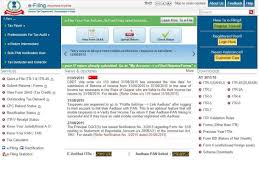
10 points to focus when e-filing your income tax return
by K.Sundar | posted in: Corporate Updates, Economy, Business Updates, Corporate Affairs, Income Tax,e-Filing- Individuals, Firms, Companies | 0

10 points to focus when e-filing your income tax return


The income tax return (ITR) has to be filed by everyone whose income exceeds the basic exemption limit as allowed by the government regulations. However, the Indian government has made the ITR filing process quite easy and convenient by introducing on-line filing or e-filing. Unlike the traditional physical paper filing, e-filing saves time and enables users to calculate exemptions, claim refunds and avoid delays. Even then, many people make a few basic mistakes and consequently get IT notices for discrepancies, extra pay taxes and penalties.


Here are 10 aspects that you should keep in mind when e-filing your ITR, successfully.

– Selecting the right ITR form: The first step is to select the appropriate ITR form. As of now, there are seven ITR forms depending on what kind of income you have. For instance, ITR1 is applicable to any individual with only salary income. On the other hand, if one has capital gain along with salary, he/she should opt for ITR2. It is mandatory to select the correct ITR form so that your income tax return filing does not get rejected by the Income Tax Department.

– Furnishing correct personal details: You are required to furnish all your personal details such as PAN , e-mail ID, contact number, bank account number and IFSC accurately to avoid rejection of your ITR filing. In case you provide a wrong PAN, the IT department will reject your e-filing as there will be a data mismatch (your details and the details generated by the wrong PAN will differ). Moreover, if you do not provide the correct mobile number and e-mail address, it will lead to incomplete e-filing as the one-time password (OTP) and any other communication will be done through your registered contact details only.

– Mentioning all sources of income: People often forget or do not bother to mention the tax-exempted amount. It is, however, advisable to mention both taxable as well as non-taxable income. Exempted income may include interest earned on savings accounts and/or fixed deposits or earning through selling shares or mutual fund units. You should mention all the sources of income in the form as not mentioning the same would be considered as ‘concealment of income’. This may lead to IT notices, as concealment of income is against the law.

– Claiming deduction under appropriate section: Claim your deductions under the appropriate section of the Income Tax Act or it may lead to more tax liabilities. For example, it is incorrect to claim employer’s contribution to the EPF under section 80C while the principal repaid for housing loan falls under section 80C. Again, if you have made some investments that are exempted under Chapter VIA, but forget to mention it while e-filing the ITR, you may lose the money by paying taxes or may lose the opportunity for tax refund. Therefore, it is essential to mention all your deductions under appropriate sections.

– Verifying tax credits: Check your Form 26AS before e-filing ITR. Form 26AS includes all your income details, taxes deducted at source (TDS), advance tax paid by you, self-assessment tax and so on. If you are a salaried person with Form 16, cross-check your income and tax details with Form 26AS to avoid any discrepancy, which may lead to less refund or more payable taxes.

– Mentioning multiple properties: If you have more than one property, whether occupied by you or not, you can claim a refund on only one property under the Income Tax Act, 1961 . Other properties will be deemed as let out and will be taxed at applicable municipal rates. It is advisable to furnish the details of all your properties or you may be accused of violation of Income Tax Act for concealment of income.

– Getting TDS deducted more than once: Such mistakes generally happen when individuals switch jobs in a single financial year. It is obvious that your first employer had sent the TDS to the government depending on the income you had earned there. However, your second employer may deduct your TDS again for the same financial year assuming you did not pay it earlier. To avoid such double deductions, it is advisable to share all your TDS details with your new employer. In the ITR form, you should disclose your income and tax details related to both organisations (or more, in case that is applicable). This will not only help you avoid double taxation, but may also provide you with more refundable amount.

– Discrepancies in TDS details: It is always advisable to check your TDS deductions and deposits made by your employer/deductor to avoid any misfiling of your ITR or losing any refund. It is possible that the deductor has failed to deposit your deducted TDS to the government. Undoubtedly, the deductor will face consequences for not depositing the same. However, it is better to avoid any delay in your refund process or pay much more in taxes due to someone else’s mistake. To avoid such consequences, cross-check your TDS deducted with Form 26AS. If your TDS is deducted and deposited to the government quoting your PAN correctly, it will reflect on your Form 26AS. If you find any discrepancy, act immediately and avoid any delay.

– Paying advance tax/self-assessment tax: It is advisable to pay the liable advance tax or self-assessment tax before March 31 of the financial year. It is normal to have income where TDS is not applicable. In such cases, you need to calculate your liable tax and pay it to the government. If you fail to do it, you will be penalized at the rate of 1 per cent per month starting from April 1 of the next financial year.

– Verifying ITR-V: The process of e-filing does not end with submitting your ITR form. You should send the acknowledgement (ITR-V) – the IT Department will share it on your registered email ID – to CPC, Bangalore. This step is not required if you have e-filed your ITR with digitized signature / e-verified. The ITR-V should be sent via speed post within 120 days after filing your ITR. Further, keep a track of the ITR-V to ensure that it reaches the CPC timely. If the CPC does not receive your ITR-V within 7-10 days of posting, contact them on their toll-free number 1800-425-2229 and resend the copy.

If you keep in mind the above-mentioned points while e-filing your ITR, you will not face any delay or cancellation of return, and may get refund swiftly.

For any assistance in e-filing the Income Tax Returns, you can contact our team of charted accountants, who can help to file a proper response and for filing of Returns, or any tax related queries so that compliance can be made duly.

CPC Bengaluru, E-Filing, Electronic Verification Code (EVC), Form 26AS, Income Tax (IT), Income Tax Return (ITR), Online, Permanent Account Number (PAN)

Posts pagination

« 1 2 3 4 5 6 7 8 »

Recent Posts

  • MCA Extends Due Date for Filing AOC-4 and MGT-7 till 31 December 2026: Major Relief for Companies

    MCA Extends Due Date for Filing AOC-4 and MGT-7 till 31 December 2026: Major Relief for Companies

  • CBDT extends I-T return filing deadline for audit cases to November 21

    CBDT extends I-T return filing deadline for audit cases to November 21

  • Fixed Late Fee for Tax Audit Report (AY 2026-27): What is applicable

    Fixed Late Fee for Tax Audit Report (AY 2026-27): What is applicable

  • The Micro, Small and Medium Enterprises Development (Amendment) Bill, 2026 Passed by Parliament: A New Era for India’s MSME Sector

    The Micro, Small and Medium Enterprises Development (Amendment) Bill, 2026 Passed by Parliament: A New Era for India’s MSME Sector

  • CBDT to show foreign financial information in AIS &Form 26 AS

    CBDT to show foreign financial information in AIS &Form 26 AS

  • MCA introduces CCFC-2026 to ease compliance by Corporates

    MCA introduces CCFC-2026 to ease compliance by Corporates

  • The new Income Tax Act, 2025 replaces old Act of 1961

    The new Income Tax Act, 2025 replaces old Act of 1961

© 2026 SunKrish Globecons Private Limited