The Ministry of Corporate Affairs has simplified the DIR-3 KYC process, moving from annual filing to a triennial cycle.

The Ministry of Corporate Affairs (MCA) has simplified the DIR-3 KYC process, moving from annual filing to a triennial cycle. Under these amended rules, directors with an active DIN must now file the Form DIR-3 KYC Web once every three consecutive financial years, due by June 30th.

The Ministry of Corporate Affairs (MCA) has amended the DIR-3 KYC framework effective 31 March 2026, replacing the annual filing requirement with a triennial cycle. Directors must now file Form DIR-3 KYC Web once every three years by 30 June, significantly reducing compliance burden while ensuring updated records.

Key Highlights of the Amendment

  • Effective Date: 31 March 2026 (vide G.S.R. 943 (E) dated 31 December 2025).
  • New Filing Cycle: Once every three consecutive financial years instead of annually.
  • Due Date: Filing must be completed by 30 June of the year following the third financial year.
  • Unified Form: Both DIR-3 KYC (e-form) and DIR-3 KYC Web have been merged into a single Form DIR-3 KYC Web.
  • Mandatory Updates: Any change in mobile number, email ID, or residential address must be updated within 30 days.
  • Digital Signature Requirement: Only needed if updating mobile, email, or residential address.

Compliance Process Timeline

Check DIN status

Ensure your Director Identification Number (DIN) is active and previous KYC filings are up to date.

Prepare updated details

Gather PAN, mobile number, email ID, and residential address for verification.

Access MCA portal

Log in to the Ministry of Corporate Affairs portal and select Form DIR-3 KYC Web.

Complete triennial filing

Submit the unified KYC form once every three years by 30 June.

Update changes promptly

File updates within 30 days for any change in mobile, email, or address.

Re-activate DIN if needed

Use the form to reactivate a deactivated DIN with applicable late fees.

Implications for Directors

  • Ease of Compliance: Reduced frequency of filings saves time and effort.
  • Governance Integrity: Mandatory updates within 30 days ensure accuracy of records.
  • Transition Period: Directors who have already filed KYC remain compliant until their next cycle due in 2028.
  • Penalty Avoidance: Non-filing may lead to DIN deactivation; timely compliance is crucial.

Professional Takeaway

This amendment strikes a balance between ease of doing business and regulatory oversight. Directors should mark their compliance calendars for the new triennial cycle and ensure prompt updates to avoid penalties. For corporate secretaries and compliance officers, this change simplifies monitoring obligations while maintaining governance standards.

MCA V3 Portal: Transforming Corporate Compliance in India

The Ministry of Corporate Affairs (MCA) has launched the MCA V3 portal, a significant upgrade over the earlier V2 system. This transition marks a new era in corporate compliance, offering improved efficiency, transparency, and user experience for companies, professionals, and regulators.

Here are the key highlights that you need to know about the newly launched V3 portal and how it impacts your business.

The V3 portal is designed to promote “Ease of Doing Business” through automation and real-time data integration.

Key Improvements Over MCA V2

Feature

MCA V2 Portal

MCA V3 Portal

Forms

Static PDF-based filings

Web-based forms with dynamic fields and real-time validations

Login

Password-based

Email + OTP login for enhanced security

Filing Process

Manual attachments, repetitive data entry

Pre-filled fields, linked filings, and conditional STP (Straight Through Processing)

Dashboard

Basic interface

“My Application” dashboard for tracking drafts, submissions, and status

Validation

Errors detected post-submission

Real-time validation before submission, reducing rejections

Utility Mode

Excel/PDF uploads

Web forms with integrated Excel utility

Transition Support

Limited guidance

Detailed FAQs and guides for professionals

Benefits for Stakeholders

  • Companies & Professionals: Reduced compliance burden through automation and pre-filled data.

  • Regulators: Improved accuracy and transparency with real-time validations.

  • Public Users: Enhanced accessibility and security with OTP-based login.

Improvements at a glance:

The MCA V3 portal is not just an upgrade—it is a transformation of India’s corporate compliance ecosystem. By introducing web-based forms, real-time validations, and a modern dashboard, MCA has significantly improved efficiency, accuracy, and transparency. For professionals and companies, mastering V3 is now essential to ensure smooth compliance in the digital era.

Conclusions

The digital transformation of company registration through MCA V3, combined with the surge in new company & LLP formation, marks one of the most important recent trends in India’s corporate regulatory space. It reflects both policy reform and entrepreneurial energy.

For anyone looking to start a business, this is a good time — the system is getting more entrepreneur-friendly, incorporating healthy corporate practices and more conducive for new ventures. 

The MCA V3 portal is a ambitious step toward a paperless, transparent corporate environment. While the learning curve and initial glitches are challenging, the long-term benefits of real-time processing and integrated compliance would save businesses significant time.


CBDT extends ITR-6 filing deadline: What Taxpayers need to know

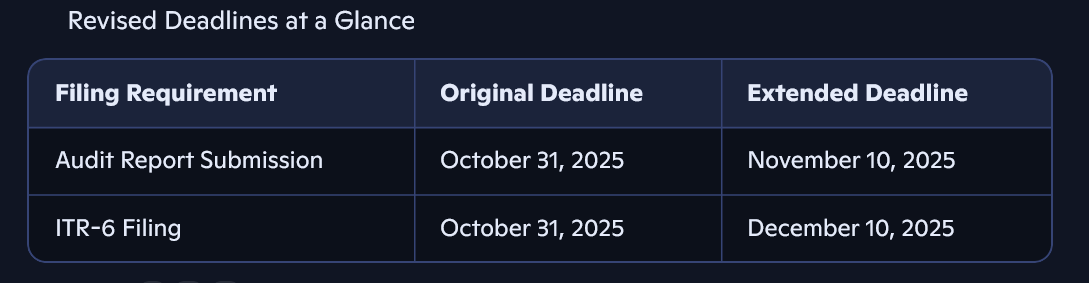
The Central Board of Direct Taxes (CBDT) has extended the due date for filing ITR-6 for AY 2025–26 by 10 days, moving the deadline from October 31 to December 10, 2025. This extension applies to companies and entities requiring audited financials.

In a welcome move for corporate taxpayers and professionals, the Central Board of Direct Taxes (CBDT) has announced a 10-day extension for filing Income Tax Return (ITR-6) for the Assessment Year (AY) 2025–26. The revised deadline is now December 10, 2025, replacing the earlier cutoff of October 31, 2025.

Who does this apply to?

This extension specifically benefits:

  • Companies and entities whose accounts are subject to audit under the Income-tax Act, 1961.
  • Assessees covered under clause (a) of Explanation 2 to sub-section (1) of Section 139, which includes firms and individuals with mandatory audit requirements.

Why the Extension?

The decision follows industry representations and logistical challenges faced by tax professionals in meeting the original deadlines. It also aligns with a recent Gujarat High Court directive that extended the audit report deadline to November 30, 2025.

Implications for Taxpayers

  • More time for compliance: Companies now have additional breathing room to finalize audited accounts and file returns accurately.
  • Avoid penalties: Timely filing by the new deadline helps avoid late fees and interest under Section 234F.
  • Better quality submissions: The extension allows for thorough review and error-free filings, especially for complex corporate structures.

What should you know?

  • Update your compliance calendar to reflect the new deadlines.
  • Coordinate with auditors to ensure timely submission of audit reports by November 10.
  • Prepare ITR-6 filings with all required disclosures, including tax audit details, transfer pricing reports (if applicable), and financial statements.

This extension is a strategic relief for stakeholders navigating the complexities of corporate taxation. As deadlines shift, staying proactive and organized remains key to smooth compliance. If you’re a tax professional or company executive, now’s the time to realign your filing strategy and ensure timely submission under the revised schedule.

Source: CBDT Circular

MCA grants extension of time for filing Financial Statements and Annual Returns till December 31,2025

This scheme aims to grant a condonation of delay to LLPs regarding the filing of Form-3, Form-4, and Form-11 from September 1, 2023 to September 30, 2023.

In a significant move to ease compliance pressure, the Ministry of Corporate Affairs (MCA) has extended the deadline for companies to file their financial statements and annual returns for the financial year (FY) 2024–25 without additional fees until December 31, 2025, according to General Circular No. 06/2025 issued on October 17, 2025.

The extension was granted due to the deployment of revised e-forms on the MCA-21 Version 3 portal and requests from stakeholders.

The new deadline for filing financial statements and annual returns is December 31, 2025, with only normal fees applicable during this period.

This extension does not alter the statutory deadline for holding Annual General Meetings (AGMs). Companies should hold their AGM within the statutory deadline and file forms before December 31, 2025, to avoid extra fees. For more details, refer to the General Circular No. 06/2025.

The circular provides relaxation for the filing of following forms:

  • Form AOC-4 – Filing of financial statements
  • Form AOC-4 (CFS) – Consolidated financial statements
  • Form AOC-4 XBRL / Non-XBRL – For companies required to file in structured formats
  • Form MGT-7 / MGT-7A – Annual return for companies and small companies/OPCs respectively

Companies must take care that the ROC forms/returns are filed correctly and within the given date. Not adhering to the instructions can lead them to deal with various penalty charges and legal consequences.

Therefore, it is recommended that companies reach out to professionals to assist them in ensuring compliance with the filing needs.

Source: General-circular-20251017

MCA extends due date for filing DIR-3 KYC and DIR-3 KYC-WEB till Oct 31, 2025

The Ministry of Corporate Affairs has issued General Circular No. 06/2025 dated October 17, 2025, allowing companies to file their financial statements and annual returns for FY 2024–25 using the newly revised e-Forms (MGT-7, MGT-7A, AOC-4 series) on the MCA-21 Version 3 portal without additional fees until 31st December 2025.

This relaxation aims to help companies adapt to the new forms but does not extend statutory deadlines for holding AGMs under the Companies Act, 2013. Companies failing to meet statutory timelines remain liable for legal action, and filings made after this period will attract normal and additional fees as per applicable rules.

The Ministry has revised the e-Forms MGT-7, MGT-7A, AOC-4, AOC-4 CFS, AOC-4 NBFC (Ind AS), AOC-4 CFS NBFC (Ind AS), AOC-4 (XBRL) for annual filings, which were deployed on the MCA-21 Version 3 portal recently.

In view of the deployment of the new e-Forms, and considering that companies may require some time to get familiarized with the filing process, and keeping in view the requests received from various stakeholders, it has been decided that companies will be allowed to complete their annual filings pertaining to FY 2024-25 till 31st December, 2025 without payment of additional fees.

However, it is hereby clarified that this General Circular shall not be construed as conferring any extension of statutory time for holding of AGMs by the companies under the Companies Act, 2013 (the Act) and the companies which have not adhered to the relevant statutory timelines shall continue to be liable to legal action under the appropriate provisions of the Act.

Any filings made subsequent to the currency of this General Circular would attract payment of all fees, including additional fees, as provided in the Companies (Registration Offices and Fees) Rules, 2014, from the date when such filings were actually due under the Act.

This is issued with the approval of the Competent Authority.

Source: Gen-circular-5-20251015- Reg DIR 3 KYC

MCA extends due date for filing DIR-3 KYC

MCA extends DIR-3 KYC filing deadline to October 15, 2025: A sigh of relief for directors

The Ministry of Corporate Affairs (MCA) has announced a much-awaited extension for filing the DIR-3 KYC and DIR-3 KYC-WEB forms without additional fees. This provides directors with more time to complete their annual compliance requirements.

Key takeaways from the extension

  • Revised Due Date: The deadline has been extended from the usual September 30, 2025, to October 15, 2025.
  • No Additional Fee: The extension allows DIN holders to file their KYC details without incurring the standard ₹5,000 late filing penalty.
  • Applicability: The extension covers both e-form DIR-3 KYC (for first-time filers or those updating details) and the web-based DIR-3 KYC-WEB (for subsequent annual filings with no changes).
  • Reason for Extension: The MCA granted the extension after receiving requests from stakeholders to provide more time for compliance.

Who needs to file?

The DIR-3 KYC filing is a mandatory annual compliance requirement for every individual who holds a Director Identification Number (DIN). This includes:

  • Every DIN holder, regardless of whether they are currently serving as a director in a company or a designated partner in an LLP.
  • Even individuals whose DIN has been deactivated for non-compliance are required to file the form to reactivate it.

The importance of timely filing

Filing your DIR-3 KYC is a simple yet crucial step to ensure your director status remains active and compliant. Here’s why you should use this extension wisely:

  • Avoid DIN Deactivation: Failure to file the form by the new deadline will result in the deactivation of your DIN.
  • Prevent Penalties: If you miss the extended deadline, you will have to pay a steep penalty of ₹5,000 to get your DIN reactivated.
  • Maintain Corporate Governance: Timely compliance ensures that the MCA maintains accurate and updated records of directors, which is vital for corporate transparency and governance.

What you need to do

  1. Gather Information: Ensure you have your personal mobile number and email ID ready for OTP verification.
  2. Access the Portal: Log in to the MCA V3 portal to initiate the filing process.
  3. Choose the Correct Form: Select the appropriate form based on your filing history: e-form DIR-3 KYC (for first-timers or updates) or web-form DIR-3 KYC-WEB (for subsequent filings with no changes).
  4. Complete the Process: Verify your details and submit the form before October 15, 2025, to avoid any late fees.

Final thoughts

This extension is a welcome move by the MCA, especially for those who faced challenges during the initial filing period. It provides a valuable opportunity to complete the necessary compliance without the burden of additional fees. Directors are advised to take advantage of this extension and file their DIR-3 KYC forms at the earliest to ensure a smooth and penalty-free compliance process.

Source: MCA Circular

CBDT Extends Due Date for Filing Audit Reports: Relief for Taxpayers and Professionals

CBDT extends due date, taking into account the hardships faced by taxpayers and the representations received from professional bodies, by  one-month relief for audit report submissions.

The Central Board of Direct Taxes (CBDT) has announced a significant relief for taxpayers and professionals by extending the due date for filing various audit reports under the Income-tax Act, 1961. The deadline, which was earlier set for 30th September 2025, has now been extended to 31st October 2025 for the Assessment Year (AY) 2025–26.

Why Was the Extension Granted?

The decision came after multiple representations from professional associations, including Chartered Accountant bodies, who highlighted the challenges faced by taxpayers and practitioners in completing audits on time.

Key reasons cited include:

  • Natural calamities such as floods in several regions, which disrupted normal business and professional activities.
  • Court petitions filed before various High Courts seeking relief.
  • Heavy workload on tax professionals, especially after the individual ITR filing deadline in mid-September.

Interestingly, CBDT clarified that the Income-tax e-filing portal has been functioning smoothly, with no major technical glitches. By 24th September 2025, over 4.02 lakh Tax Audit Reports (TARs) had already been uploaded, with more than 60,000 TARs filed in a single day.

Who Needs to File a Tax Audit Report?

Under Section 44AB of the Income-tax Act, tax audit is mandatory for:

  • Businesses with turnover above ₹1 crore (limit increases to ₹10 crore if cash transactions are ≤ 5%).
  • Professionals with gross receipts above ₹50 lakh.
  • Taxpayers under presumptive taxation (Sections 44AD/44ADA/44AE) if they declare lower profits than prescribed and their income exceeds the basic exemption limit.

What Happens If You Miss the Deadline?

Failure to file the audit report within the due date can attract penalties:

  • 0.5% of turnover/gross receipts, subject to a maximum of ₹1.5 lakh.
  • The penalty is discretionary and may be waived if reasonable cause is demonstrated.

Impact on ITR Filing Deadlines

Currently, the due date for filing Income Tax Returns (ITRs) for taxpayers subject to audit remains 31st October 2025. However, experts suggest that CBDT may issue a separate notification to extend the ITR filing deadline to 30th November 2025, in line with past practice.

Key Takeaways

  • New due date for filing audit reports: 31st October 2025.
  • Reason for extension: Natural calamities, workload pressure, and professional representations.
  • E-filing portal status: Stable and fully functional.
  • Relief provided: Extra time for taxpayers and professionals to ensure accuracy and compliance.

Conclusion

The extension of the audit report filing deadline by CBDT is a welcome move, offering much-needed breathing space to taxpayers and professionals alike. While the e-filing system is robust, real-world challenges such as natural disasters and workload bottlenecks cannot be ignored. This proactive step ensures compliance without undue stress, reinforcing CBDT’s commitment to balancing efficiency with empathy.