GST 2.0: What changed at the recent GST Council meeting – rates, processes and what it means

GST Council, has recommended to reduce / waive the interest/ late fee for delayed filing of GSTR 3B by small taxpayers (having turnover upto Rs. 5 crores) for the tax period from July 2017 to July 2020
The GST Council has announced major rate cuts and compliance reforms in its September 2025 meeting. Highlights of new GST slabs, effective dates, process changes, and how businesses should prepare.

India’s GST system just received its biggest shake-up since rollout: the GST Council approved a major rate rationalisation (moving to a much simpler slab structure), together with a package of taxpayer-friendly process reforms. The changes – aimed at reducing complexity, lowering prices for many everyday goods, and speeding up compliance/refunds for businesses – are to be implemented from 22 September 2025 (with a few exceptions and phased rollouts). Here’s a clear, practical, and source-backed breakdown of what happened, why it matters, and what businesses and consumers should expect next.


Main Highlights

  • Two main GST slabs: 5% (merit/essential) and 18% (standard) — the 12% and 28% slabs are being collapsed into these. A special de-merit 40% rate is proposed for a small set of luxury/sin goods (tobacco, very high-end vehicles, etc.).


  • Implementation date: Most changes effective 22 Sept 2025 (Navratri start). Tobacco/pan masala items will have separate timing. Some elements may be phased to manage compensation fund impacts.


  • Process reforms: Faster/automated registration for low-risk businesses, pre-filled returns, auto/refund acceleration, risk-based provisional refunds for exporters and a timeline to operationalise many tech changes.


  • Anti-profiteering approach: legal anti-profiteering machinery (Section 171) hasn’t been reinstated in an aggressive form — the government is asking industry to pass on benefits while monitoring and states are pushing for safeguards. Expect guidance from tax authorities.


What exactly changed – the rate map (summary)

The Council rationalised slabs to simplify compliance and broaden the “common man” gains.

  • 5% slab — Will cover a large set of essentials, many medicines/healthcare inputs, basic food items and several household staples and smaller consumer items previously at 12%/18%. (Examples reported: roti, many edible goods, certain medicines and diagnostic kits, small household appliances in some categories).


  •  8% slab — The standard rate now for most manufactured goods and many services previously at 18%/28%/12% where reclassification makes sense (e.g., many auto components, some consumer durables moved to 18%).


  • 40% de-merit slab — A higher, selective rate for luxury and sin goods (tobacco products, very high-end cars, other items identified by the Council). These are explicitly carved out to preserve revenue and to tax dis-incentivise harmful/very high-end consumption.


Implementation mechanics & phasing

  • Effective date: The Council recommended implementation from 22 September 2025 for most goods/services. Tobacco and tobacco-related items will have separate treatment (different effective date to be notified) because of compensation cess and administrative considerations. Some elements (especially where compensation cess/compensation fund is concerned) may be phased to smooth state receipts.


  • Why phased? Several states flagged potential revenue loss concerns; the Council stressed consensus but also acknowledged fiscal impacts and decided to manage timing and the compensation cess account accordingly. Expect circulars from CBIC explaining exact implementation steps (tariff notifications, HSN crosswalks, valuation/credit rules). 


Process reforms (big ticket operational changes)

The meeting wasn’t just about rates – there’s a parallel package to make compliance quicker and less painful:

  1. Automated/simplified registration for low-risk applicants (target: 3 days/automated approval for eligible applicants). This aims to cut onboarding friction for SMEs and startups.


  • Prefilled returns & auto refunds — prefilled return architecture and auto refunds (including provisional/90% provisional refunds for exporters based on risk evaluation for specific sectors) to speed liquidity to business. Rollouts/timelines were announced — many measures to be operationalised by October–November 2025.


  • Faster refund windows (seven-day targets for specific exporters/priority cases) and risk-based provisional mechanisms to reduce stuck refunds.


  • Tribunal and dispute reforms — strengthening appellate/ADR mechanisms (e.g., national benches for Advance Rulings) to improve consistency in rulings.

These process reforms are intended to complement rate rationalisation so taxpayers – especially MSMEs and exporters — face lower compliance cost and faster cash flows. 


Anti-profiteering and price transmission

  • The Council/officials have made it clear that industry is expected to pass benefits of lower GST to consumers. The strict anti-profiteering law (Section 171) hasn’t been robustly re-invoked as a new enforcement blitz, but states have insisted on safeguards and monitoring. Tax authorities and state governments will watch prices and may ask for evidence of benefit transmission; businesses should act cautiously and transparently. 

Practical tip for retailers/manufacturers: document the cost/repricing methodology, issue credit notes where appropriate and update pricing policies — this is both good business practice and a defensive step in case of state queries.


Sectoral winners and losers — who gains, who pays more

  • Likely beneficiaries (cheaper): FMCG staples, many food items, certain medicines & diagnostic reagents, entry-level autos and components, many household goods and some construction materials (cement, tiles — reported moves from 28→18% / 12→5% for specific items). These cuts will help consumer demand and reduce input costs for industries like housing and consumer durables. 


  • Likely paying more / targeted up-taxed: Very high-end cars, tobacco & pan masala, certain luxury goods moved into the 40% de-merit slab (aim: revenue neutrality and disincentive). 

Stakeholder notes: Auto dealers, consumer durables firms and textiles have broadly welcomed the move as demand stimulative; states with manufacturing-heavy revenue bases have flagged short-term revenue pain and asked for compensatory arrangements. 


How decisions were made (short explanation of the Council process)

  • The GST Council is a constitutional body (Article 279A) that makes recommendations on rates and other GST matters. Decisions are taken with a weighted voting mechanism (Centre has one-third weight, states two-thirds) and normally by a three-fourths weighted majority — but in practice the Council aims for consensus. The 56th meeting reported unanimous consensus on the package. 

What to watch next

  • Notifications from CBIC/CBIC circulars giving precise tariff/HSN crosswalks, valuation rules and timeline for phased items. (Those will be the legally binding documents.) 


  •  State responses about compensation/temporary support if they claim revenue shortfalls — any fiscal transfers or special measures will be announced in coming weeks.


  • Price monitoring: watch for state consumer affairs departments and tax authorities asking firms to show price transmission evidence.


Final take

This is a large, pro-consumer and pro-growth move designed to simplify GST’s complexity and spur demand ahead of the festive season — while also modernising the compliance stack (faster registration/refunds). It’s politically significant (broad consensus) and technically big — businesses should act fast to align systems, pricing and documentation. States’ fiscal positions will be the main political/implementation watchpoint, so expect more operational clarifications from CBIC in the coming days.



Navigating Capital Gains Tax for FY 2024-25 (AY 2025-26)

The Union Budget 2024 introduced significant changes to capital gains taxation, particularly effective from July 23, 2024, which taxpayers across India need to be aware of to ensure compliance and efficient filing.
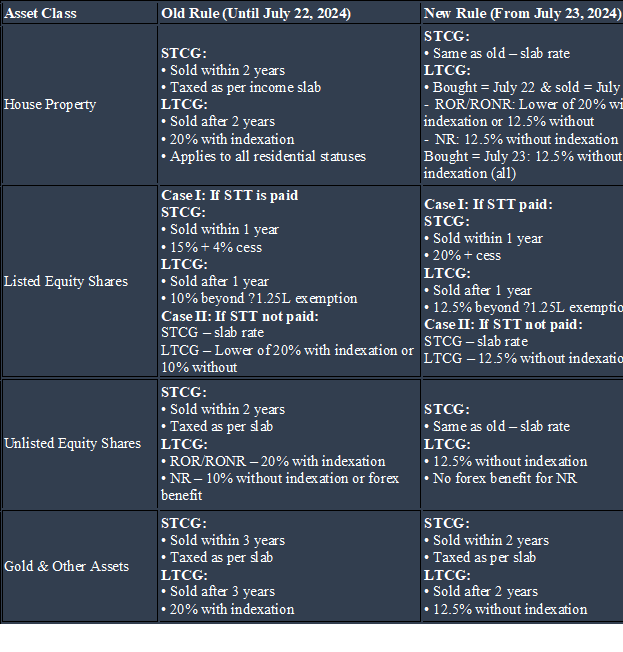
The capital gain tax rules were changed in the mid-year from FY 2024-25 (Asst Year 2025-26). Due to this, a taxpayer needs to be aware of both the old and new rules to pay the correct tax, depending on the date of sale. Here is a handy guide for individual taxpayers who have STCG and LTCG from houses, listed equity, unlisted equity, gold, and other assets. 


Key Changes to Capital Gains Taxation (Effective July 23, 2024)
The Union Budget 2024-25 has introduced notable adjustments, particularly impacting long-term capital gains (LTCG) and the application of indexation benefits.


* Increased Tax Rates: The tax rates for both short-term capital gains (STCG) and long-term capital gains (LTCG) have been revised. STCG on specified financial assets where Securities Transaction Tax (STT) is paid has increased from 15% to 20%. For most asset types, the LTCG tax rate has been raised from 10% to 12.5%.


* Revised LTCG Exemption Limit: The annual exemption limit for LTCG arising from the sale of equity shares or equity-oriented units has been increased from ₹1 lakh to ₹1.25 lakh.


* Indexation Benefit Changes: A significant change is the removal of indexation benefits for most assets transferred on or after July 23, 2024. This means the purchase price will not be adjusted for inflation, potentially leading to higher taxable gains.

Asset-Specific Capital Gains Tax Ready Reckoner

Here’s a breakdown of how capital gains are taxed for different asset classes, considering the pre- and post-July 23, 2024 scenarios:

  1.  House Property
    The taxation of house property capital gains depends on the date of acquisition and sale, as well as your residential status.
    * Short-Term Capital Gains (STCG): If a house property is sold within 24 months of purchase, the gains are considered STCG and are taxed according to your applicable income tax slab rates, irrespective of your residential status (Resident Ordinary Resident – ROR, Resident Not Ordinary Resident – RONR, or Non-Resident Indian – NRI).
    * Long-Term Capital Gains (LTCG):
    * Property bought on or before July 22, 2024, and sold on or after July 23, 2024:
    * ROR/RONR individuals have an option: pay 20% tax with indexation benefit or 12.5% tax without indexation. Taxpayers can choose the more beneficial option.
    * NRIs will pay 12.5% tax without indexation.
    * Property bought on or after July 23, 2024: LTCG will be taxed at a flat 12.5% without indexation for all taxpayers, regardless of residential status.


2. Listed Equity Shares
The tax treatment for listed equity shares depends on whether STT has been paid.
* STCG (Sold within 1 year):
* If STT is paid: Taxed at 20% plus cess (for transfers on or after July 23, 2024).
* If STT is not paid: Taxed at your income tax slab rates.
* LTCG (Sold after 1 year):
* If STT is paid: Taxed at 12.5% beyond the ₹1.25 lakh exemption limit (for transfers on or after July 23, 2024).
* If STT is not paid: Taxed at 12.5% without indexation.


3. Unlisted Equity Shares
* STCG: Taxed at your income tax slab rates.
* LTCG: Taxed at 12.5% without indexation. Note that NRIs do not receive forex benefits on unlisted equity.


4. Gold and Other Assets
* STCG (Sold within 2 years): Taxed at your income tax slab rates.
* LTCG (Sold after 2 years): Taxed at 12.5% without indexation under the new rules. Under old rules, a 3-year holding period for LTCG was applicable, taxed at 20% with indexation.

Filing Your Income Tax Return (ITR) for FY 2024-25 (AY 2025-26)
The Income Tax Department has enabled online utilities for filing ITR-2 and ITR-3 forms, which are relevant for individuals and Hindu Undivided Families (HUFs) with capital gains income.
* ITR-2: Used by individuals and HUFs who have income from capital gains but do not have earnings from business or profession.
* ITR-3: Applicable to taxpayers including stock traders, with provisions for reporting capital gains and other specified incomes.


Key Changes in Capital Gains Taxation: 


  1. Flat LTCG Rate Introduced

– New Rate: Long-Term Capital Gains (LTCG) are now taxed at 12.5% across most asset classes.

– Old Rate: Previously, LTCG was taxed at 20% with indexation or 10% without indexation, depending on the asset.

– Impact: For assets acquired after July 23, 2024, indexation is not allowed, which may increase tax liability if inflation-adjusted cost was significantly higher.


1. STCG Rate Hiked for Listed Equities

– New Rate: Short-Term Capital Gains (STCG) on listed equities now taxed at 20% (up from 15%).

– Impact: Traders and short-term investors face higher tax liability.


2.  LTCG Exemption Limit Raised

– New Limit: Exemption on LTCG from listed equity and equity mutual funds increased to ₹1.25 lakh (from ₹1 lakh).

– Impact: Slight relief for small investors.


3.  Indexation Benefit Restricted

– Allowed Only If: Property was acquired before July 23, 2024.

– Impact: For newer acquisitions, no indexation, which may result in higher taxable gains.


4. Holding Period Simplified

– Listed Securities: LTCG if held >12 months.

– Other Assets: LTCG if held >24 months.

– Impact: Easier classification, but may affect timing strategies.

Conclusion:

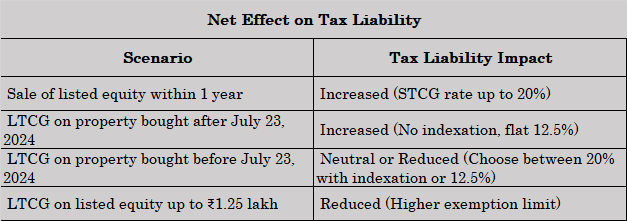
The capital gains tax amendments for Assessment Year 2025–26 have introduced a mix of increases and simplifications, depending on the asset type and transaction date. Here’s a breakdown of how they affect tax liability:

Choosing the right ITR Form for AY 2025–26: A Simple Guide

The CBDT has released the Income Tax Return forms for Assessment Year 2025–26. One big change this year affects salaried individuals and small business owners who earn long-term capital gains (LTCG) from listed shares or mutual funds. If the gains are up to Rs 1.25 lakh a year, they can now file returns using ITR-1 or ITR-4 forms.

ITR filing is mandatory for individuals who have an annual income exceeding the basic exemption limit.

There are various types of Income Tax return forms that taxpayers have to fill to complete filing Income Tax Return process.

These ITR forms are classified on the basis of the nature of income.

The Central Board of Direct Taxes (CBDT) releases a set of ITR forms tailored for different categories of taxpayers.

Choosing the right form is crucial for filing and for processing without any delays.

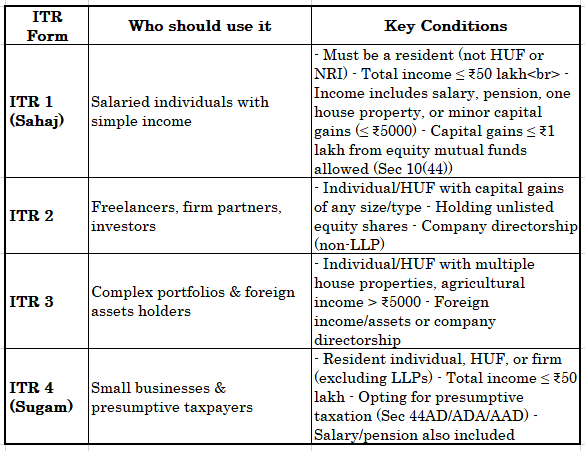
Here is a simplified guidance of the main ITR forms applicable for Assessment Year 2025–26: 


ITR-1 Form: This form is for a resident individual whose total income includes-

  • Income earned from salary or Pension.
  • Income from other sources, excluding income from winning a lottery or income from owning and maintaining race horses, is taxable under section 115BBDA or section 115E.
  • Income from One House Property; however, in this form, the loss brought forward from previous years are not eligible.
  • Income from agriculture activities up to Rs 5000.
  • The total income of the individual should not exceed 50 Lakhs.

ITR-2 Form: This form is for individuals or a HUF (Hindu Undivided Family) whose income includes:

  • Income from salary or Pension
  • Income from House Property(one or more)
  • Income from other sources, including income from winning a lottery, income from owning and maintaining horse races, or income taxable at special rates.
  • Persons who had investments in unlisted equity shares at any time during the entire financial year.
  • An individual who is a director in a company.
  • An individual who is a Resident (ROR/RNOR)or non-resident.
  • Income earned from capital gains
  • Income from foreign assets/ other foreign income.
  • Agricultural income of more than Rs 5,000/-
  • Incomes where clubbing provisions are applicable
  • Individuals having a financial interest in assets located outside India, which includes any signing authority for accounts held outside India.
  • One who desires to carry forward or bring forward loss under income from house property.
  • Any tax has been deducted under Section 194N
  • In cases where payment or deduction of tax has been deferred on ESOP (Total income can exceed 50 lakhs in this ITR Form)

ITR-3 Form: This form is to be used by either an individual or a Hindu Undivided Family who are carrying on a profession or a business. The following persons are eligible to fill this form:

  • The residential status can be either Non-resident or Resident (ROR/RNOR)
  • If a person is the director of the company.
  • Persons who had investments in unlisted equity shares at any time during the entire financial year.
  • Income from other sources
  • Income of a person who is a partner in a firm.
  • Income from salary or Pension
  • Income from House Property(one or more)
  • Total income can exceed 50 lakhs in this case.
  • Income earned from capital gains or foreign assets/foreign income.
  • Who has income under the head profits or gains of business or profession and who is not eligible to file Form ITR-1 (Sahaj), ITR-2, or ITR-4 (Sugam).
  • In short, individuals or HUFs who are not eligible to file ITR-1, ITR-2, and ITR-4 should file ITR-3

ITR-4 Form: This form is applicable to both the resident individuals and HUFs.

  • Other than LLPs, all partnership firms which are residents and have an income that is either professional or from the business.
  • Those persons who have opted for a presumptive income scheme according to Section 44AD, Section 44AE, and Section 44ADA of the Income Tax Act.
  • If the person’s business turnover exceeds Rs. 2 crores, then he is required to file ITR-3 with the Audit report and not ITR 4.
  • The total income for ITR 4 should not exceed Rs. 50 lakhs.
  • Income from One House Property(loss brought forward from previous years or carry forward of losses are not eligible in this ITR Form ).
  • Income from Salary or Pension.
  • Income from other sources. (excluding income from winning a lottery or income from owning and maintaining race horses, income taxable under section 115BBDA or 115BE).

Why it matters

Filing the right form is important, for processing of the ITR and to get refund, if applicable. If right form is not filed, it can lead to:

  • Return being marked as defective
  • Loss of deductions and refunds
  • Extra scrutiny from tax authorities

Each form aligns with specific income types and taxpayer profiles. A salaried individual with no investments doesn’t need the complexity of ITR 3. Similarly, a small business owner can save time with ITR 4 using the presumptive taxation scheme.

Tips for filing

  • Use the latest instructions issued by the Income Tax Department.
  • Double-check PAN and bank details. It speeds up refund processing.
  • Declare all sources of income, even those exempted, like interest from PPF.
  • Use Form 26AS and AIS to cross-check what the department already knows about your earnings.


SEBI opens Special Window for re-lodgement of Physical Share Transfers

Ease of Doing Investment – Special Window for Re-lodgement of Transfer Requests of Physical Shares

The Securities and Exchange Board of India (SEBI) has announced a significant update aimed at helping investors who missed earlier deadlines for transferring physical shares. In a circular dated July 2, 2025 (Ref: SEBI/HO/MIRSD/MIRSD-PoD/P/CIR/2025/97), SEBI is introducing a six-month special window to re-lodge transfer requests that were submitted before April 1, 2019 but rejected or unattended due to documentation issues.

🗓 Key Dates

  • Special window period: July 07, 2025 – January 06, 2026
  • Eligible transfers: Transfer deeds lodged prior to April 01, 2019 and returned/rejected/not processed due to deficiencies

🔍 What’s Changing?

  • Investors now get one final opportunity to re-lodge their transfer deeds.
  • All transfers under this window will be processed exclusively in demat mode.
  • Requests pending with RTAs or listed companies as of now are also covered.

🛠 Implementation Guidelines

  • Public Awareness: Stock Exchanges, RTAs, and listed companies must publicize the window bi-monthly through print and social media.
  • Dedicated Teams: RTAs and listed companies are required to create focused teams to handle these requests.
  • Monthly Reporting: RTAs/companies must submit reports to SEBI on:
  • Number of requests received, processed, approved, and rejected
  • Average processing time
  • Publicity measures taken
    (Format provided in Annexure-A of the circular)

🏛 Regulatory Backing

This move is powered by SEBI’s authority under:

  • Section 11(1) of the SEBI Act, 1992
  • Regulation 102 of the SEBI (LODR) Regulations, 2015
  • SEBI (Registrars to an Issue and Share Transfer Agents) Regulations, 1993

💡 Why It Matters

For investors who were stuck due to missed deadlines or minor procedural lapses, this is a chance to reclaim their investments and bring their holdings into the digital demat ecosystem. It also aligns with SEBI’s ongoing efforts to protect investor rights and streamline the securities market.

SEBI’s Circular: Special Window for Re-lodgement of transfer requests of Physical Shares

CBDT extends ITR filing deadline to September 15, 2025

CBDT Extends Income Tax Return Filing Deadline to September 15, 2025

Taxpayers across India can breathe a sigh of relief, as the Central Board of Direct Taxes (CBDT) has officially extended the Income Tax Return (ITR) filing deadline for Assessment Year (AY) 2025–26 from July 31, 2025, to September 15, 2025. This extension provides additional time for taxpayers to comply with new structural and content changes introduced in the revised ITR forms.

Why the Deadline has been extended?

The decision comes as a response to delays in issuing the new ITR forms and utilities, which have undergone extensive revisions this year. The Ministry of Finance has stated that these updates aim to:

  • Enhance transparency in tax reporting,
  • Simplify compliance for taxpayers, and
  • Enable more accurate reporting of income and deductions.

Since these modifications require system upgrades, the Income Tax Department needed extra time to ensure seamless integration, system readiness, and accurate reflection of TDS credits.

Official Announcement

The Income Tax Department took to social media platform X (formerly Twitter) to share the update, stating:

“This extension will provide more time due to significant revisions in ITR forms, system development needs, and TDS credit reflections. This ensures a smoother and more accurate filing experience for everyone.”

Key Takeaways

  • New Deadline: September 15, 2025
  • Reason for Extension: Delays in updated ITR forms and system readiness
  • Objective: Better compliance, transparency, and reporting accuracy

What This Means for You?

As you are yet to file your Income Tax Return (ITR), this announcement is good news! You now have additional time to:

  • Review the revised ITR forms carefully,
  • Gather necessary documents to ensure accurate filing, and
  • Avoid last-minute errors by leveraging the extended timeline.

With the extra time granted, taxpayers are encouraged to file their returns promptly instead of waiting until the last minute. Stay informed and ensure smooth tax compliance!

Source : CBDT Circular

MCA V3 Portal ushering in a significant digital transformation

The dawn of a New Era: MCA’s V3 Portal phases out V2 for enhanced Corporate Compliance

The Ministry of Corporate Affairs (MCA) has ushered in a significant digital transformation, completing the phased migration of its services from the older V2 portal to the advanced MCA21 V3 portal. This move marks a pivotal moment for businesses, professionals, and stakeholders involved in corporate governance in India, promising a more streamlined, efficient, and user-friendly experience.

A Gradual but Definitive Shift

For quite some time, the MCA has been strategically transitioning its functionalities. While LLP-related filings were among the first to move to V3, the final and most comprehensive set of 38 company e-forms, including crucial annual filing forms like AOC-4 and MGT-7, and various audit/cost audit forms, went live on 30th May, 2025. This launch to be effective (from July 14, 2025 from 12.00 a.m) renders the V2 portal obsolete for company filings, signifying the completion of a major technological overhaul.

Why the Shift? The Promise of V3

The move to V3 is not merely an aesthetic upgrade; it’s a fundamental re-engineering of how corporate compliance is managed. Here’s what makes V3 a game-changer:

Online Form Submission: A major departure from V2, V3 allows for direct online submission of forms, eliminating the need to download, fill, and then upload. This significantly reduces manual effort and potential errors.

Enhanced User Experience: V3 boasts a more intuitive and responsive web design, making navigation and filing more user-friendly. Features like e-Adjudication, e-Consultation, and a Learning Management System are integrated for a holistic experience.

Real-time Processing and Tracking: Stakeholders can now track the status of their filings in real-time, providing greater transparency and allowing for timely corrective actions if needed.

Streamlined E-payments: The payment process has been further refined for greater ease and security. Notably, the “Pay Later” option on V2 has been discontinued, emphasizing online payment modes.

Improved Data Integrity and Compliance Management: V3 incorporates advanced field-level validations and aims to minimize errors during filing. The Compliance Management System (CMS) will assist MCA in identifying non-compliant entities and issuing e-notices, strengthening the regulatory framework.

Single User ID for Multiple Roles: Professionals (CA/CS/CMA) who are also directors can now manage their various roles through a single user ID, simplifying their interactions with the portal.

Increased Accessibility and Transparency: The portal aims to improve the accessibility of public documents and offers better resolution of public grievances.

Key Dates and Important Actions for Stakeholders

To ensure a smooth transition, the MCA had laid out a clear timeline and advised stakeholders on crucial actions:

V2 Filing Disabled: Company e-filings on the V2 portal were disabled from June 18, 2025. It was critical for all Service Request Numbers (SRNs) to be clear of “pending payment” or “re-submission” status before this date.

Offline Payments Discontinued: The “Pay Later” option in V2 was stopped from June 8, 2025, mandating online payments for all filings.

V3 Portal Downtime: A scheduled downtime for the V3 portal occurred from July 9 to July 13, 2025, to facilitate the final rollout of the new forms.

User ID and DSC Updates: Stakeholders were strongly advised to create a new user ID or upgrade/merge their existing V2 ID to a “Business User” category in V3 and associate their Digital Signature Certificate (DSC) without fail.

SRN Updates: SRNs requiring updates regarding investor or subsidiary details needed to be completed by June 17, 2025, to avoid being marked as “NTBR” (Not to Be Registered).

Navigating the new landscape: What to expect

While V3 promises significant improvements, like any large-scale system migration, initial teething troubles are not uncommon. Stakeholders should be prepared for:

Familiarization with New Interface: It will take some time for users to get accustomed to the new layout and functionalities of V3.

Technical Glitches: While the MCA has taken steps to ensure a smooth transition, occasional technical issues related to login, DSC association, or form submission might arise.

Proactive Engagement: Users are encouraged to utilize the FAQs and support resources provided by MCA and professional bodies to resolve any issues promptly.

The phasing out of the V2 portal and the full embrace of V3 signify the MCA’s commitment to digital governance and ease of doing business in India. This advanced platform is set to enhance transparency, streamline compliance processes, and contribute to a more robust corporate ecosystem. Embracing this new era with readiness and adaptability will be key for all stakeholders.

Source: MCA Circular

Income Tax Bill, 2025 to replace Income Tax Act, 1961: Key Changes

Finance Minister Nirmala Sitharaman has presented the new Income Tax Bill 2025 in Parliament today, February 13, 2025. This presentation marks a significant step in reforming India’s direct tax system.

Key Features of the Bill

The Income Tax Bill 2025 is designed to replace to the six-decade old Income Tax Act, 1961, with the goal of making direct taxes simpler.

Simplification and Structural Overhaul:

The idea is to get rid of old, confusing parts of the law and make the language easier to understand. Currently, the tax law has 298 sections and 14 schedules, but the new bill aims to shorten this considerably. The new bill is a substantial document at 622 pages, but it’s expected to cut down the number of sections by about 25-30%. This should make it easier for taxpayers to understand the rules and follow them.

Introduction of ‘Tax Year’ Concept:

One key change is the introduction of the term “Tax Year,” replacing “Assessment Year” and “Previous Year.” This aligns India’s tax system with the financial year and international practices.

This change is aimed at simplifying tax compliance and reducing ambiguities in filing returns, aligning with best global practices.

No Change in Tax Rates and Slabs:

The bill does not propose changes to existing tax rates or slabs. The current categories of tax heads including salaries, house property, and capital gains remain unchanged.

Emphasis on Digital Transactions:

The bill strongly promotes digital transactions. It includes provisions for easier electronic record-keeping and tax filing, reflecting the global shift towards digital finance. Virtual Digital Assets (VDAs), such as cryptocurrencies, are now recognized and taxed like other assets.

Residency Criteria with clearer Guidelines:

Under Section 6 of the 1961 Act, an individual was considered a resident of India if they stayed in the country for 182 days in a financial year or 60 days in specific cases. However, Clause 6 of the Bill retains these broad parameters but has brought forth refined provisions for individuals with multiple citizenships or complex residency situations. This change provides greater transparency and eliminates loopholes that were often exploited in international tax planning.

Revised Heads of Income and Deductions

Traditionally, income has been classified into five heads – Salaries, House Property, Business/Profession, Capital Gains, and Other Sources, all of which remains in the new bill. However, Clauses 13 to 59 expand these categories to explicitly include income from virtual assets, digital businesses, and online earnings.

The revisions modernize income classifications while ensuring that new-age revenue streams are properly accounted for under tax laws.

Capital Gains and other deductions Overhaul

The 1961 Act offered various deductions and exemptions under Sections 10 and 80C to 80U, covering investments, donations, and other expenses.

The 2025 Bill, through Clauses 11 to 154, consolidates these deductions and introduces new provisions benefiting startups, digital businesses, and renewable energy investments. Additionally, the standard deduction for salaried individuals has been increased to ₹75,000, providing significant relief to middle-income taxpayers.

The taxation of capital gains, previously covered under Sections 45 to 55A, remains largely intact in the new bill but is dealt with key refinements. Clauses 67 to 91 introduce specific provisions for virtual digital assets (VDAs) and update holding period thresholds for certain asset classes.

Modern investment instruments such as cryptocurrencies and digital securities are also slated to be accommodated within the new provisions by means of these inclusions.

Automation and Faceless Assessments

.Previously, tax administration under Sections 139 to 158 relied heavily on manual processes for return filing, audits, and assessments. The new bill, in Clauses 263 to 389, mandates e-filing, faceless assessments, and automated taxpayer interactions, reducing human intervention and increasing transparency.

Business Thresholds for Presumptive Taxation:

For businesses, the threshold for the presumptive tax scheme is proposed to be increased. Businesses with a turnover of up to ₹3 crore can now opt for this scheme, up from the previous limit of ₹2 crore. The threshold for professionals has also been raised from ₹50 lakh to ₹75 lakh.

Tax Audits and Compliance:

Regarding tax audits, Chartered Accountants (CAs) will continue to be the primary professionals responsible. The bill does not include Company Secretaries (CSs) or Cost Accountants (CMAs) in this role. The emphasis on digital processes and reduced direct interaction aims to improve compliance and lessen the risk of harassment for taxpayers.

Stricter Compliance

The General Anti-Avoidance Rules (GAAR) that had a limited scope under Sections 95 to 102 of the Income Tax Act, 1961 have been significantly strengthened in the new bill. Clauses 178 to 184 provide for broader GAAR coverage, stricter scrutiny of impermissible tax arrangements, transactions lacking commercial substance and enhanced measures against tax evasion.

Non-Profit Organizations

While Sections 11 to 13 of the Income Tax Act, 1961 Act provided tax exemptions for non-profit entities, they lacked detailed compliance measures. Clauses 332 to 355 in the new bill introduce a comprehensive regulatory framework that imposes stricter compliance and reporting requirements to prevent misuse of tax benefits.

Dispute Resolution Mechanism

Under the 1961 Act, taxpayers had access to a Dispute Resolution Panel (DRP ) under Section 144C, mainly for foreign companies. The 2025 Bill, through Clause 275, expands the DRP’s scope and introduces a Dispute Resolution Committee (DRC ) under Clause 379, catering specifically to small and medium taxpayers for quicker and more efficient dispute resolution.

Speedy Redressal

Clauses 268 to 296 of the new bill gives tax officers expanded powers to request asset and liability statements, introduces faceless scrutiny through Clause 273, and shortens reassessment timelines by means of Clauses 279 to 285.

The appellate process has also been streamlined, with first appeals now allowed at the Joint Commissioner level (Clause 356), while the ITAT and High Court procedures (Clauses 362-365) have been simplified for efficiency. A new Board for Advance Rulings has also been introduced through Clause 381 to improve tax predictability for businesses.

Implications for Taxpayers

The immense changes introduced through the Income Tax Bill, 2025 aims to streamline taxation, eliminate ambiguities, and promote compliance through automation, digital inclusion, and modernized tax rules.

The introduction of faceless assessments, expanded digital income classifications, and stricter anti-evasion measures paves the way for India’s tax system to navigate through the next phase of economic growth.

Process and Implementation

After it’s introduced, committees will review it. It will go to the Standing Committee on Finance for their suggestions, and then the cabinet will review it again before it goes back to Parliament for a final vote. The plan is for the new law to take effect on April 1, 2026, which is the beginning of the new financial year.

Major Reform

 This new bill is part of a bigger effort to update tax laws, lessen the amount of legal disputes over taxes, and make the tax rules clearer.

The introduction and later implementation of the 2025 Income Tax Bill is a major change to how taxes work in India. The goal is to make tax laws more transparent and simpler, while also adapting to the current economic situation.