Key changes in new Income Tax Return (ITR) forms

The Finance Act, 2015 abolished the wealth-tax. Thus, taxpayers are no longer required to file returns of wealth tax from assessment year 2016-17 onwards. However, the Hon’ble Finance Minister in his budget speech had announced that information which was to be furnished in wealth tax return will now form part of Income Tax Returns (ITR).

Thus, in new ITR forms, namely, ITR-1, ITR-2, ITR-2A and ITR-4S the Government has imposed obligation on Individuals and HUFs having income exceeding Rs 50 lakhs to furnish information regarding assets and liabilities.

2.0 Changes made in new ITR forms:-

2.1 Declaration of value of assets and liabilities by Individuals/HUF earning above Rs 50 lakhs:-

[ITR 1, 2, 2A, 3, 4, 4S]

The new ITR forms introduce a new Schedule requiring individuals/HUFs to declare the value of assets and liabilities if their total income exceeds Rs. 50 lakhs. Assets include immovable assets and movable assets. Under the heading immovable assets, taxpayers have to disclose cost of land and building. Under movable assets cost of Jewellery, bullion, vehicles, Yachts, boats, aircraft and cash in hand need to be disclosed. Further, such taxpayers need to disclose all liabilities in relation to such assets.

Note: Individuals and HUFs with income exceeding 25 lakhs, filing ITR-3 and ITR-4 were already required to furnish information of their assets and liabilities. Now such threshold limit of 25 lakhs has been increased to 50 lakhs in new ITR-3 and ITR-4 for disclosure of details of assets and liabilities.

2.2          TCS credit for individual taxpayers:-

[ITR 1, 2, 2A]

Sub-section (1D) was inserted in Section 206 by the Finance Act, 2012 to reduce the practice of cash payments for purchase of bullion and Jewellery and for curbing the flow of unaccounted money in the trading system.

Section 206(1D) provides that the seller of bullion and Jewellery shall collect TCS at 1% of sale consideration from buyer if such sale consideration is received in cash and it exceeds:

i) 2 lakh, in case Bullion; and

ii) 5 lakh, in case of Jewellery.

However, in the absence of any row in the ITR Forms (ITR 1, 2 and 2A), individual taxpayers were unable to claim credit of such TCS. Therefore, new ITR Forms provide an option to claim TCS by the individual taxpayers.

2.3          Firms can file ITR-4S for presumptive income:-

[ITR-4S]

Under the existing provisions of Rule 12, firms were required to file ITR 5 even for presumptive income. The amended Rule 12 would now allow firms to file ITR 4S for presumptive income. Accordingly, a separate row is provided for in ITR 4S to claim deduction of interest and salary paid by the firms to the partners.

2.4        Additional deduction for contribution to NPS under Section 80CCD :-

[ITR 1, 2, 2A, 3, 4 and 4S]

A new sub-section (1B) was introduced in Section 80CCD by the Finance Act, 2015 to provide for an additional deduction of upto Rs. 50,000 for investment in National Pension Scheme. Accordingly, a new row is now introduced in the ITR Forms to claim benefits of such additional deduction.

2.5          Details of pass through income of business trust or investment fund:-

[ITR 2, 2A, 3, 4, 5, 6, 7]

As per provisions of Section 115UA and Section 115UB,pass through status is provided in respect ofincome [other than income from business or profession] of business trust/investment fund. Thus, income distributed by the business trust/investment fund is to be taxed in the hands of the unit holders.

The new ITR Forms have a new ‘Schedule PTI’ for reporting of pass through income of business trust/investment fund. Following details should be provided by such trust in ITR forms:

■  Name of business trust/investment fund

■  PAN

■  Head of income

■  Amount of income

■  TDS on such amount, if any.

2.6 Disclosure of details regarding partnership firm by a partner:-

[ITR 3, 4]

In ITR forms there is a separate ‘Schedule IF’ wherein partners are required to disclose the name of the partnership firms in which he is a partner. Now partners have to disclose whether such firm is liable to transfer pricing audit under Section 92E. Separate column has been inserted for such purpose in ‘Schedule IF’.

2.7 Share of income from firm/AOP/BOI:-

[ITR 3, 4, 5, 6]

Share of income from partnership firm, AOP and BOI is exempt from tax in hands of recipient. However, such exempt income had to be disclosed in old ITR forms under ‘Schedule EI’. Now, disclosure of such exempt income has been done away with in new ITR forms.

2.8 Deduction of additional investment allowance:-

[ITR 4, 5, 6]

Section 32AD was inserted by the Finance Act, 2015 to provide for an additional investment allowance to an undertaking set-up in the notified backward areas in the States of Andhra Pradesh or Telangana. Suitable safeguards have been provided in the provision for restricting the transfer of the plant or machinery for a period of 5 years. On transfer of such asset within five years, the amount of deduction already allowed shall be deemed as income from business or profession (i.e., deemed income under Section 32AD) in the year of transfer.

A separate row has been inserted in new ITR forms to claim such deduction under Section 32AD. Further, a separate row is provided to offer the deemed income to tax under Section 32AD.

2.9 Effect of Income Computation and Disclosure Standards (‘ICDS’):-

[ITR 4, 5, 6]

New ‘Schedule ICDS’ has been inserted in ITR forms wherein effect of Income Computation and Disclosure Standards (‘ICDS’) on profit needs to be disclosed.

2.10       Percentage of commercial receipts by a trust:-

[ITR 7]

The Finance Act, 2015 has substituted the proviso to Section 2(15) to provide that the advancement of any other object of general public utility shall not be a charitable purpose, if it involves the carrying on of any activity in the nature of trade, commerce or business, unless:

i) such activity is undertaken in the course of actual carrying out of such advancement of any other object of general public utility; and

ii) the aggregate receipts from such activity or activities during the previous year, do not exceed 20% of the total receipts, of the trust or institution undertaking such activity or activities, of that previous year.

In other words, advancement of any other object of charitable purpose shall not be deemed as charitable if receipts from any commercial activity exceed 20% of total receipts. Accordingly, a new row is inserted in ITR 7 to disclose percentage of commercial receipts vis-à-vis total receipts in order to ensure that such condition (as given hereinabove) is not violated.

2.11       Application of income by a trust:-

[ITR 7]

Income of charitable or religious trust is exempt if 85% of its income is applied for charitable or religious purposes in India. If income applied for charitable or religious purposes during the previous year falls short of 85% because such income has not been received during the year or due to any other reason, an option is given to assessee to apply such income in future years in prescribed manner. Assessee has to choose such an option by filing Form 9A to the Assessing Officer before due date of filing return of income under Section 139(1).

Now a separate row is provided in new ITR 7 requiring trust to confirm if it has filed Form 9A to exercise such an option and the date of filing of such form.

2.12       Details to be given by Universities, hospitals, educational institutions:-

[ITR 7]

Exemption under sub-clause (iiiab) and (iiiac) of Section 10(23C) is available to universities or educational institutions, hospitals or other institutions which are wholly or substantially financed by the Government, subject to certain prescribed conditions. The Finance Act, 2015 has amended the provisions of Section 139 to provide that such entities covered under clauses (iiiab) and (iiiac) of Section 10(23C) shall be mandatorily required to file their returns of income.

Now such universities, hospitals, educational institutions, etc., have to disclose their name and annual receipts in new ITR 7. Further, they are also required to disclose the amount eligible for exemption in ITR 7.

2.13       Minimum Alternate Tax (MAT) disclosure:-

[ITR-6, 7]

The Finance Act, 2015 had excluded following incomes for computing MAT liability:

i) Share of a member in the income of the AOP/BOI, on which no income-tax was payable.

ii) Passive income (like capital gains, interest, royalty, FTS) accruing or arising to foreign company if income-tax payable thereon was less than 18.5%.

iii)  Amount representing:

–          Notional gain on transfer of a capital asset, being share of SPV to a business trust in exchange of units allotted by that trust referred to in clause (xvii) of Section 47; or

–          Notional gain resulting from change in carrying amount of said units; or

–          Gain on transfer of units referred to in clause (xvii) of section 47.

iv) Loss on transfer of units referred to in Section 47(xvii) (subject to conditions)


Consequently, the Finance Act, 2015 had provided for addition of related expenditure on aforesaid income while computing MAT liability.

Separate row have now been inserted in ITR forms to incorporate such changes.


2.14       Disclosure of Audit information:-

[ITR 5, 6]

In new ITR forms there is a separate row for disclosure of following details if taxpayer is liable for audit under any Act [other than the Income Tax Act]:

1)         Act and Section under which taxpayer is liable for audit

2)         Date of furnishing of Audit Report.

2.15 Deduction of sum paid for purchase of sugarcane:-

[ITR-5]

The Finance Act, 2015 had inserted Section 36(1)(xvii) to provide that co-operative society, engaged in the business of manufacturing of sugar, could claim deduction of expenditure on purchase of sugarcane to the extent of price approved or fixed by the Government. Expenditure in excess of such fixed price was to be disallowed.


New ITR-5 has inserted a separate row for disclosure of sum which is disallowable under Section 36(1)(xvii).

2.16 Deduction under section 80JJAA:-

[ITR 4, 5]

Old provisions of section 80JJAA, inter alia, provided for deduction to an Indian company, deriving profits from manufacture of goods in a factory. The quantum of deduction allowed was equal to 30% of additional wages paid to the new regular workmen employed by the assessee in such factory, in the previous year, for three assessment years including the assessment year relevant to the previous year in which such employment was provided.

With a view to encourage generation of employment, the Finance Act, 2015 had amended Section 80JJAA so as to extend the benefit of such provision to all assessees having manufacturing units rather than restricting it to corporate assessees only.

New ITR-4 and ITR-5 forms now contain a separate row for such taxpayers (other than corporate taxpayers) to claim benefit of such deduction under Section 80JJA


Private sector lender Federal Bank to support startups

Jumping on to the startup bandwagon, Kerala based private sector lender Federal BankBSE -1.38 % is opening incubation centres in Bangalore and Ernakulam exclusively for startups. These would be specialised lounges within Federal Bank branches meant for funding advisory, regulatory support and if required even for direct investment.

“We have a dedicated startup fund worth Rs 25 crore which we would like to use to fund or lend to promising startups. These lounges, named Launchpad, with fast internet connections, support staff from the financial world and advisory mechanisms would be the perfect breeding ground for future entrepreneurs,” said Shyam Srinivasan, managing director, Federal bank.

The lounge would be manned by bank officers who would be capable of dealing with the financial requirements of the startups as well as local specialists who would be able to advise on regulatory issues that entrepreneurs need to handle.

“We are talking to 3 or 4 startups daily. The challenge for a bank is to move away from a conservative credit mind set to a more entrepreneurial mind set and to accept the fact that out of 40 or 50 investments only one might take off. So even we are in the process of understanding how to engage with startups better,” he said.

The bank follows the footsteps of HDFC Bank and Bank of Baroda to integrate their platform with mobile payments application Chillr. The addition that Federal Bank brings to the Chillr app is that they would allow even non Federal Bank users to instantly open a Federal Bank account through a selfie and Aadhar identification number and allow them to receive payments through Chillr.

“This is just another offer in the suite of offerings for the customer. We are in the major discovery process slowly there would be convergence in this field,” said Srinivasan.

How FIIs outsmart domestic investors

Domestic investors have a lot to learn from their foreign institutional counterparts, who seem to have mastered the art of timing, raking in the moolah in the midst of market volatility.

On the other hand, domestic investors mostly buy when foreign institutional investors (FIIs) are booking profits at higher valuations, limiting their own upside.

For example, in the current rally, most of the FII purchases were in 2012 and the first half of 2013, when the price-to-earnings (PE) multiple of BSE 500 companies had hit a multi-year low.

In contrast, most of the accumulation by domestic investors, through mutual funds and insurance companies, occurred in 2015 when BSE 500 companies were trading at a multi-year PE high. FIIs accumulated India’s top-listed companies at an average valuation of around 16 times and offloaded it to domestic investors at around 24 times their value (see chart).


In all, FIIs’ stake in BSE 500 companies was up 550 basis points between March 2012 and March 2015, at an average PE of around 16 times the companies’ combined trailing 12-month net profits. FIIs stake peaked in the March 2015 quarter, coinciding with the peak in valuations of BSE 500 companies. One basis point is one-hundredth of a per cent.

The analysis is based on the end-of-quarter shareholding pattern, market capitalisation and quarterly net profit of BSE 500 companies, beginning the March 2006 quarter. The sample is based on the data for 358 companies where the data is comparable across the period.

Analysts attribute this to the steady nature of fund flows FIIs receive, while domestic institutional investors are at the mercy of inflows from retail investors, which tend to take place late in the cycle.

“When FIIs were buying in 2012-13, insurance companies and mutual funds were still facing redemption, forcing fund managers to sell their holdings even when the valuations were low. Inflows turned positive only in late 2014 and 2015, when domestic retail investors were convinced about the rally,” said Dhananjay Sinha, head, institutional equities, Emkay Global Financial Services.

In comparison, FIIs receive a significant portion of their funds from large institutional investors in Europe and the US, whose investment sentiment remains steady over a long period.

Others also point to differences in the investing styles of FIIs and their domestic counterparts.

“FII investments are largely fundamental and research-driven compared to domestic investors, most of whom tend to get swayed by market sentiment and herd mentality,” said G Chokkalingam, the founder and chief executive officer of Equinomics Research & Advisory.

This explains why a majority of domestic investors fail to make money in the market, he added.

A similar trend was visible in the rally before the global financial crisis, when FIIs were net sellers for nearly two years in the run-up to the September 2008 crash while domestic investors were buyers.

Despite the trends, some analysts differ.

Nitin Jain, the president and chief executive officer of global asset and wealth management firm Edelweiss Capital, said there is no evidence of domestic investors being less smart than their foreign counterparts.

“We should not paint all FIIs with the same brush. Investment flows from exchange-traded funds, which is retail money – as volatile and sentiment-driven as domestic retail and mutual funds flows. FIIs, on the other end of the spectrum, also get pension money and sovereign wealth funds, which are long-term and their investment style is similar to that of domestic insurance companies,” said Jain.

Source: http://www.business-standard.com/article/markets/how-fiis-outsmart-domestic-investors-116032800052_1.html

E-commerce sees major money inflow

It is not only Uber, the American taxi-hailing app, that is going all guns blazing in India with massive investment plans. Its biggest competitor, Bengaluru-based Ola, as well as e-commerce entities Flipkart and Amazon, are all planning to pump in big money to stay ahead, even in a scenario when investors are not as ready as earlier in opening their purse-strings.

Uber India has readied itself for another $500 million (Rs 3,300 crore) investment in the next three months, reports suggest. The app service had only nine months earlier committed $1 billion (Rs 6,600 crore) in India. Uber could not be reached for a comment.

For foreign giants such as Amazon, Uber and Alibaba, this country is a big market they all want to capture. Experts believe this is a trend which will continue, as a global economic slowdown will push a chunk of new investments towards India.

“We can clearly see a slowdown in overseas markets, while India is still managing annual growth of seven to eight per cent. So, companies such as Uber, Amazon and Alibaba want to bet big on India. While Amazon was not able to make a dent in China and Alibaba in Europe, they do not want to lose out on India. We will see this trend through the year,” says Amarjeet Singh, partner – tax, KPMG in India.

Ola, rival of Uber in the same segment, is on track to invest a chunk of its $1.3 billion (Rs 8,650 crore) capital raised so far. The firm recently announced it would invest Rs 200 crore in the Delhi-National Capital Region area over the next six months, “towards innovative green fuel technology, leasing of CNG cars and strengthening the system to catalyse greater CNG adoption in the region”, Rahul Maroli, its vice-president for strategic supply initiatives had said.

According to sources, Ola will further make strategic investments in all metro cities, as well as in Tier-II and Tier-III towns. “The company plans to add at least another 550,000 vehicles by the end of this year,” said one. Ola has at least 350,000 cabs and 80,000 auto rickshaws on its platform across 102 cities in the country.

American e-commerce major Amazon had said in October 2014 it was investing $2 billion (Rs 13,200 crore) in India. Later, its executives said the group had an open chequebook for the market. In February, it bought Noida-based payments services provider Emvantage, its first acquisition. This is aimed to help Amazon accelerate the development of payment solutions for customers.

As for Alibaba, the Chinese e-commerce giant, it already has a foothold in Indian e-commerce through its investments. The group is majority stakeholder in One97Communications, owner of mobile payments giant Paytm. Also, online marketplace major Snapdeal raised $500 million (Rs 3,300 crore) from a group of entities last year which included Alibaba.

The Chinese company now plans to directly enter India.

“We plan to enter the e-commerce business in India in 2016,” recently said J Michael Evans, group president. “We have been exploring very carefully the opportunity in this country, which we think is very exciting against the backdrop of (the) Digital India (programme of the government).”

Indian e-commerce giant Flipkart had, in March, infused Rs 338 crore into its online fashion store, Myntra, documents filed with the registrar of companies stated. Flipkart has so far raised $3 billion (nearly Rs 20,000 crore).

Source: http://www.business-standard.com/article/companies/e-commerce-sees-major-money-inflow-116032800986_1.html

New bankruptcy bill to speed up shutdown of failed businesses

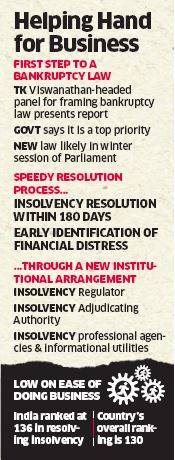
Panel has sought the overhaul of the bankruptcy framework to allow the speedy winding up of failed businesses to protect shareholders and lenders, aiming to modernise an outdated system.

A government panel has sought the overhaul of the bankruptcy framework to allow the speedy winding up of failed businesses to protect shareholders and lenders, aiming to modernise an outdated system that drags out closure proceedings.

It has recommended new institutions and structures for a fresh regime that will encourage entrepreneurship and foster a startup culture, among the stated objectives of the Narendra Modi administration. The government has indicated it will move a Bill in the winter session of Parliament to give effect to the recommendations, addressing one of the key issues that has kept India low on the ease of doing business rankings.

The Bankruptcy Law Reform Commission headed by former law secretary TK Viswanathan has proposed insolvency resolution within 180 days and a new regulator to oversee the process. It’s also laid down a clear and speedy system for early identification of financial distress and revival of companies.

The timelines are on par with international norms for insolvency resolution. “The endeavour would be to introduce the Bill in the next session of Parliament,” Finance Minister Arun Jaitley said at the World Economic Forum in the Capital on Wednesday. Viswanathan submitted the report to the minister later in the day. The report, along with the draft legislation, has been made public for feedback. “The Bill seeks to improve the handling of conflicts between creditors and debtors, avoid destruction of value, distinguish malfeasance vis-a-vis business failure and clearly allocate losses in macroeconomic downturns,” the report said.

The World Bank has ranked India at 136 out of 189 countries in ‘resolving insolvency,’ estimating that it takes 4.3 years on average in Mumbai to settle a case.

Jaitley had identified bankruptcy law reform as a key priority for improving ease of doing business in his February budget speech. He said that a comprehensive bankruptcy code, meeting global standards and providing the necessary judicial capacity, would be unveiled in the fiscal year. Under the current system, proceedings take several years, hurting investors and lenders besides costing taxpayers crores of rupees.

Banks are groaning under bad debt stemming from projects that have got stuck, drawing the Reserve Bank of India’s concern. “We need a bankruptcy code. We need equity to be seen as equity and debt to be seen as debt. Today there’s a lot of confusion… We need that confusion to be changed,” RBI Governor Raghuram Rajan has said previously.

90 Days for Key Categories. The prescribed resolution timeline of 180 days can be cut further to 90 days from the trigger date for key categories. The proposed insolvency regulator will cover professionals and agencies specialising in the field.

The proposals include information utilities that will collect, authenticate and disseminate financial information from listed companies. An Insolvency Adjudicating Authority will hear cases by or against debtors. The Debt Recovery Tribunal should be the adjudicating authority with jurisdiction over individuals and unlimited liability partnership firms, it said. The National Company Law Tribunal (NCLT) should be the adjudicating authority with jurisdiction over companies and limited liability entities, it added.

The draft bill has consolidated existing rules relating to insolvency of companies, limited liability entities, unlimited liability partnerships and individuals, all of which are currently scattered across a number of laws, into a single legislation.

According to the draft bill, during the transition phase, the Centre will exercise all regulatory powers until the agency is established. The panel’s report suggests that an insolvency resolution plan prepared by a resolution professional has to be approved by a majority of 75% of the voting share of financial creditors. As part of the insolvency resolution process, creditors and debtors will engage in negotiations to arrive at agreeable repayment plans.

The draft proposes that any proceeding pending before the Appellate Authority for Industrial and Financial Reconstruction (AAIFR) or the Board for Industrial and Financial Reconstruction (BIFR) before the new law goes into force should stand abated or stopped.

“However, a company in respect of which such proceeding stands abated may make a reference to Adjudicating Authority within 180 days from the commencement of this law,” the recommendation said, keeping in view continuity of the process. Minister of State for Finance Jayant Sinha said the required infrastructure needed to be put in place.

“We also have to ensure that necessary judicial capacity is available,” he said. “We also need to resolve many of the situations immediately because they are short of cash in most of these bankruptcy types of cases.” The minister said the government was trying to put together a comprehensive solution where “we can resolve default and bankruptcy cases as quickly and efficiently possible.”

Industry feels the new system will create a robust and globally competitive insolvency regime. This will significantly reduce the time taken for insolvency proceedings in India, which at present, on an average basis is estimated at about 4.3 years as against only 1.7 years in high-income OECD countries,” said Chandrajit Banerjee, director general of the Confederation of Indian Industry.

“The architecture proposed by the Viswanathan committee of establishing an insolvency regulator to have oversight of the new class of insolvency professionals, agencies and information utilities will enhance the systemic efficiency of dealing with insolvency cases in a timebound manner,” he said.

Source: http://articles.economictimes.indiatimes.com/2015-11-05/news/68043912_1_bankruptcy-framework-new-bankruptcy-bill-180-days

Mallya default singes top auditing companies

Some of world’s top auditing firms, including Price Waterhouse, Grant Thornton, Deloitte LLP and Walker Chandiok & Co, are under scrutiny with a slew of regulators seeking answers on their valuation, auditing and due diligence of UB Group companies over the last few years.

Deloitte LLP conducted the financial and tax due diligence for Diageo of United Spirits Ltd (USL) which led to the $2.1 billion acquisition of the company, but could not detect the problems in annual accounts. These accounts, in turn, were prepared by PW, which was the auditor for USL between 2010 and 2011, and later by Walker & Chandiok & Co.

The accounts were disputed by Diageo in April 2015 after it found a Rs 2,100 crore hole and sought Vijay Mallya’s ouster from the USL board. Questions have also been raised by lenders on what basis Grant Thornton valued the Kingfisher brand at Rs 4,100 crore. This is now being probed by the Serious Fraud Investigation office (SFIO).

When contacted, a Grant Thornton spokesperson said the firm fully stood by its brand valuation report on Kingfisher. “We believe it was appropriate in the context of when it was done and the purpose for which it was done,” the spokesperson said.

PW declined comment but an external spokesperson said the firm had not received any communication from either the Securities and Exchange Board of India or the Enforcement Directorate. “Deloitte does not comment on client confidential matters,” its spokesperson said.

Diageo had invested in USL after the British company was given express representations that all of the receivables from Mallya entities were recoverable in full. The fund diversion worth Rs 2,100 crore from USL was later raised when KPMG, the new auditor appointed by Diageo, discovered discrepancies when it was finalising USL’s 2014 accounts. All the three years’ accounts will now have to be re-stated, according to listing norms.

In the same year, the new USL management called in PW UK for a forensic audit of the previous three years (which included auditing by its own India unit) and passed on the reports to the regulators including the Sebi, the ministry of corporate affairs and the Institute of Chartered Accountants of India.

The ICAI, sources said, had asked both PW and Walker Chandiok to explain the discrepancy. An ED official said it was surprising that none of the auditors or valuers for Diageo raised flags over the accounts manipulation or the Rs 4,000 crore diversion by USL to the British Virgin Islands in 2007.

While the auditors of USL are in the dock for cooking accounts, another marquee auditing firm — Grant Thornton is under investigation by the SFIO for its Rs 4,100 crore brand valuation of Kingfisher Airlines. It was based on this brand valuation in 2011 that Mallya raised Rs 9,100 crore from government-owned banks by offering the brand as collateral. The lenders are now holding a dud Kingfisher brand, which is finding no takers.

Sources in the ICAI said it was a redux of the Satyam scam, when some of the world’s top auditors overvalued assets before the Maytas and Satyam merger, which led to the unravelling of the scam. In the Satyam case, the ICAI had debarred two auditors from Price Waterhouse who were found guilty of professional misconduct. S Gopalakrishnan and T Srinivas were struck off the ICAI’s rolls and fined Rs 5 lakh each. A Central Bureau of Investigation court later convicted them of fraud.

Source: http://www.business-standard.com/article/current-affairs/mallya-default-singes-top-auditing-companies-116031900495_1.html

SEBI board clears wilful defaulter rules; clarifies on definition of control

SEBI says wilful defaulters would also be not allowed to take control of any other listed company.

India’s market regulator Securities and Exchange Board of India (SEBI), on Saturday, tightened the rules for so-called wilful defaulters preventing them from raising funds through public issues. The rules, however, are applicable prospectively which suggests that those who have already been termed wilful defaulters may not come within the ambit of these strictures.

Following a board meeting in Delhi, on Saturday, SEBI said that entities declared as wilful defaulters will not be allowed to raise money through sale of shares, debt securities and non-convertible preference redeemable shares to the public.

“No issuer shall make a public issue of equity securities/debt securities/non-convertible redeemable preference shares, if the issuer company or its promoter or its director is in the list of the wilful defaulters,” said a press release issued by SEBI.

Such entities will not be allowed to take control of another listed entity, SEBI said. These firms will also not be allowed to set up market entities like mutual funds. The rules are applicable prospectively, said the regulator.

At a press conference in New Delhi, UK Sinha, chairman of SEBI said that all rules made by the regulator are prospective in nature.

In January 2015, SEBI issued a draft paper proposing that wilful defaulters would not be allowed to sell shares, debt securities and non-convertible preference redeemable shares to the public. The paper had suggested that wilful defaulters be barred from taking control of another listed entity, but that they be allowed to participate in counter offers to deal with hostile takeover bids. Each of these restrictions would be applicable if the issuer, its promoter, group company or director of the issuer of such securities were in the list of wilful defaulters published by RBI, the stock market regulator had said.

The final regulations announced on Saturday are along the same lines.

Policy makers have toughened their stance against wilful defaulters as they try and improve the asset quality of the banking sector. While defaulters who are hit by external factors such as weakness in economic conditions may deserve some help from the system, policy makers feel that wilful defaulters must not be spared.

RBI has been asking banks to get tough on wilful defaulters and has a tough set of rules in place which say that anyone tagged a wilful defaulter cannot raise fresh funds from the banking system. The banking regulator, however, has been of the view that such defaulters also need to have their access to capital markets restricted. This has now happened with SEBI tightening its rules as well.

While RBI has not disclosed the quantum of loans that fall under the wilful default category, data has emerged from some large public sector banks.

Loans worth Rs.11,700 crore given by State Bank of India have been locked up as non-performing assets as nearly 1,160 defaulters have wilfully decided not to repay, PTI reported on 24 February.

Another state-owned lender, Punjab National Bank (PNB), declared 904 borrowers who owed it a combined Rs.10,869.71 crore as of December-end as wilful defaulters. PNB added 140 companies to the list of wilful defaulters in the December quarter alone.

The most prominent case in this regard is the attempt by banks and investigative agencies to recover dues from UB Group chairman Vijay Mallya, who has been declared a wilful defaulter by lenders like State Bank of India. The country’s largest lender had moved the Bangalore debt recovery tribunal (DRT) seeking an arrest warrant against Mallya. On Friday, the Enforcement Directorate (ED) issued summons to Mallya, asking him to be personally present before it on 18 March. The summons is part of ED’s probe into a money laundering case against the former liquor baron.

Definition of control

Separately, the market regulator clarified what the term ‘control’ means in the context of mergers and acquisitions (M&As) by pegging the shareholding threshold of an acquirer at 25%.

“Considering the international practices and the current regulatory environment in India, the definition of control may be amended such that control is defined as (a) the right or entitlement to exercise at least 25% of voting rights of a company irrespective of whether such holding gives de facto control and/or (b) the right to appoint majority of the non-independent directors of a company,” said SEBI in its press release.

The move is aimed at removing ambiguities that companies currently confront during takeovers. Currently, the definition of ‘control’ under the Substantial Acquisition of Shares and Takeovers (SAST) Regulations, 2011—popularly known as the Takeover Code—doesn’t specify a threshold for shareholding.

The current takeover code states that an acquirer is in ‘control’ only if the board of the company that’s being acquired gives the former the right to appoint a majority of the directors, and have the final say on management and policy decisions.

The control of management or policy decisions is through shareholding or management rights or shareholders’ agreement or voting agreements.

SEBI has also cleared a framework for protective rights with an exhaustive list of rights that do not lead to acquisition of control.

“An illustrative list of protective rights which would not amount to acquisition of control may be issued. Grant of such protective rights to an investor may be subject to obtaining the public shareholders’ approval (majority of minority),” SEBI said.

Somasekhar Sundaresan, partner, J Sagar Associates, said “The company that is declared to be a willful defaulter ought to be left out of the severity of SEBI’s measures, and instead those in control of the company alone should have been targeted. A defaulter, whether willful or not, requires restructuring, and imposing prohibitions on the business entity could in fact hurt lenders for whose benefit the policy on willful defaulters has been developed. Expanding the scope to directors would also mean that turning around a company that is accused of being a willful defaulter would become impossible since no one would join the board even after throwing out the old promoters. Detailed provisions on when a borrowing entity ceases to be a willful defaulter would be needed—it cannot be after the board is replaced since, so long as it is a willful defaulter, no one would be able to join the board.”

“The move to allow shareholders to confer the power to exercise veto rights to selected investors without getting into whether they mean “control” is a positive measure. Open offers are for the benefit of public shareholders and they must have the power to waive an open offer. This is a very mature measure of reform. Market players would keenly await what SEBI puts out as a list of veto rights aimed at investor protection will not constitute control,” added Sundaresan.

Source: http://www.livemint.com/Money/LSmk1XiZ26pZnyGj5m4ufP/Sebi-bars-wilful-defaulters-from-markets-posts-at-listed-fi.html